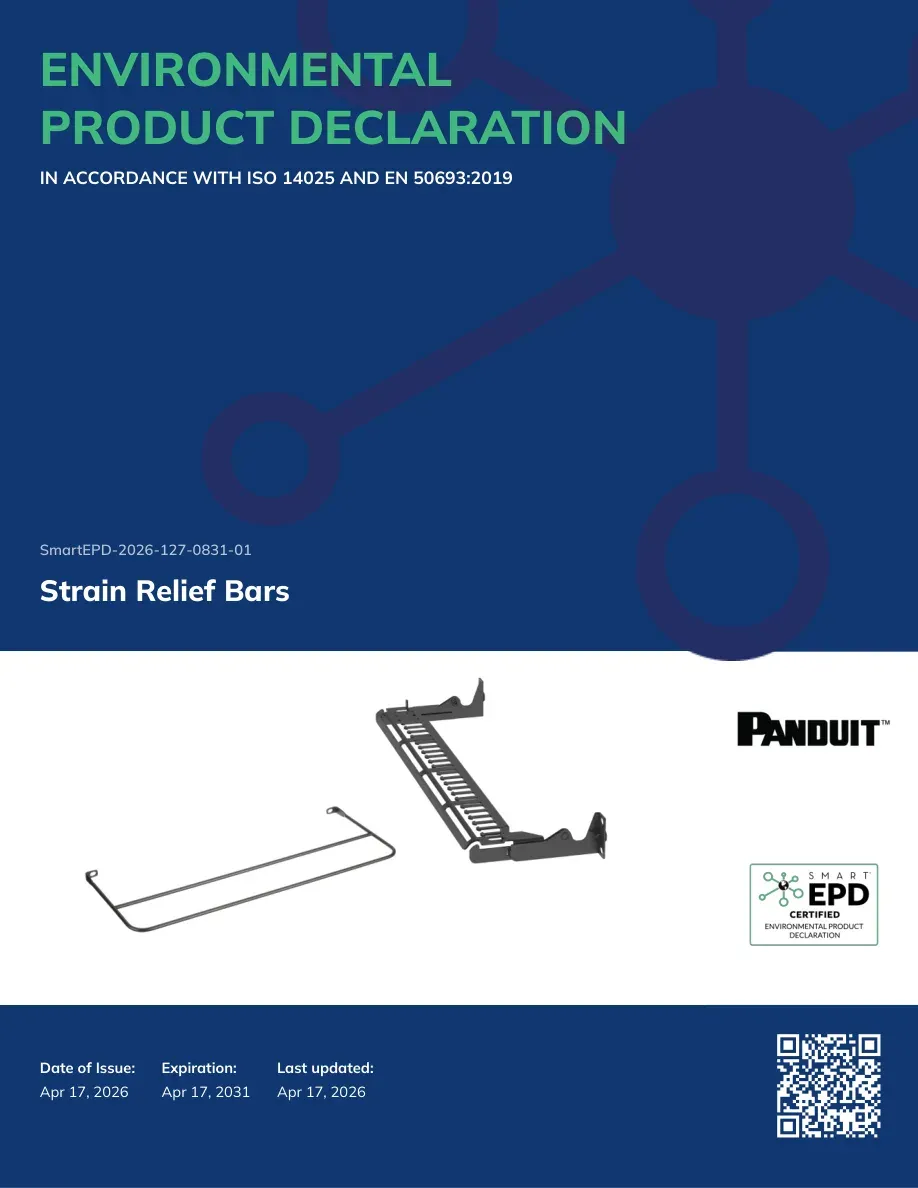
Date of Issue:Apr 17, 2026Expiration:Apr 17, 2031Last updated:Apr 17, 2026ENVIRONMENTALPRODUCT DECLARATIONIN ACCORDANCE WITH ISO 14025 AND EN 50693:2019Strain Relief BarsSmartEPD-2026-127-0831-01
General InformationPanduit Corporation18900 Panduit Drive, Tinley Park, IL 60487800-777-3300TechSupport@panduit.companduit.comProduct Name:Strain Relief BarsFunctional Unit:1 unitDeclaration Number:SmartEPD-2026-127-0831-01Date of Issue:April 17, 2026Expiration:April 17, 2031Last updated:April 17, 2026EPD Scope:Cradle to graveA1 - A3, A4, A5, B1 - B7, C1 - C4, DMarket(s) of Applicability:GlobalGeneral Organization InformationAt Panduit, we understand that what we deliver matters: high-quality infrastructure and connectivity solutions. But it’s how we deliver them that defineswho we are. We remain deeply aware of our environmental responsibilities, the importance of an inclusive workplace, and the value of transparent, ethicalgovernance. These principles guide every decision we make and shape how we serve our customers, our people, and our partners.As we’ve grown, so has our commitment—to not only deliver dependable, scalable network connectivity and powerful infrastructure, but also to embedsustainability into everything we do. By integrating environmental, social, and governance principles into our operations, we’re creating smarter solutionsthat reduce packaging waste, move products more efficiently, and support a more responsible customer journey. Today’s successes are the springboard forwhat comes next - anticipating tomorrow’s challenges so we can build a future that is more connected, resilient, and sustainable." Further information can be found at:https://www.panduit.com/en/about/about-panduit/environmental-social-and-governance.htmlLimitations, Liability and OwnershipThis declaration is an environmental product declaration (EPD) in accordance with ISO 14025 and EN 15804+A2. EPDs rely on Life Cycle Assessment (LCA)to provide information on a number of environmental impacts of products over their life cycle. Exclusions: EPDs do not indicate that any environmental orsocial performance benchmarks are met, and there may be impacts that they do not encompass. LCAs do not typically address the site-specificenvironmental impacts of raw material extraction, nor are they meant to assess human health toxicity. EPDs can complement but cannot replace tools andcertifications that are designed to address these impacts and/or set performance thresholds – e.g. Type 1 certifications, health assessments anddeclarations, environmental impact assessments, etc.Accuracy of Results: EPDs regularly rely on estimations of impacts, and the level of accuracy in estimation of effect differs for any particular product line andreported impact. Comparability: EPDs are not comparative assertions and are either not comparable or have limited comparability when they cover differentlife cycle stages, are based on different product category rules or are missing relevant environmental impacts. EPDs from different programs may not becomparable.Strain Relief BarsPanduit CorporationPage 2 / 16
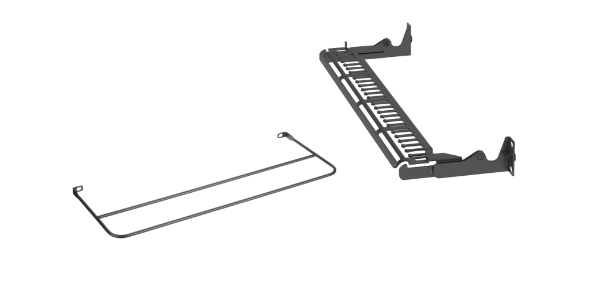
Reference StandardsStandard(s):ISO 14025 and EN 50693:2019Core PCR:PEP ecopassport® PROGRAM PCR Product Category Rules for Electrical, Electronic andHVAC-R Products (PCR-ed4-EN-2021 09 06)Date of issue: September 06, 2021Valid until: September 06, 2026Sub-category PCR review panel:Contact Smart EPD for more information.General Program Instructions:Smart EPD General Program Instructions v.2.0, March 2025Verification InformationLCA Author/Creator:Olivia JurewiczSustainable Solutions Corporationinfo2024@sustainablesolutions.comEPD Program Operator:Smart EPDinfo@smartepd.comwww.smartepd.com585 Grove St., Ste. 145, Herndon, VA 20170, USAVerification:Independent critical review of the LCA and data, according to ISO 14044 andISO 14071:ExternalArka Panditpandit_arka@outlook.comIndependent external verification of EPD, according to ISO 14025 andreference PCR(s):ExternalArka Panditpandit_arka@outlook.comProduct InformationFunctional Unit:1 unitMass:0.182 kgReference Service Life:20 YearsProduct Specificity:Product AverageProduct SpecificProduct DescriptionThis EPD presents includes the following products:Strain Relief Bar: Part Number SRB19D5BLStrain Relief Bar: Part Number SRB19D7BLStrain Relief BarsPanduit CorporationPage 3 / 16
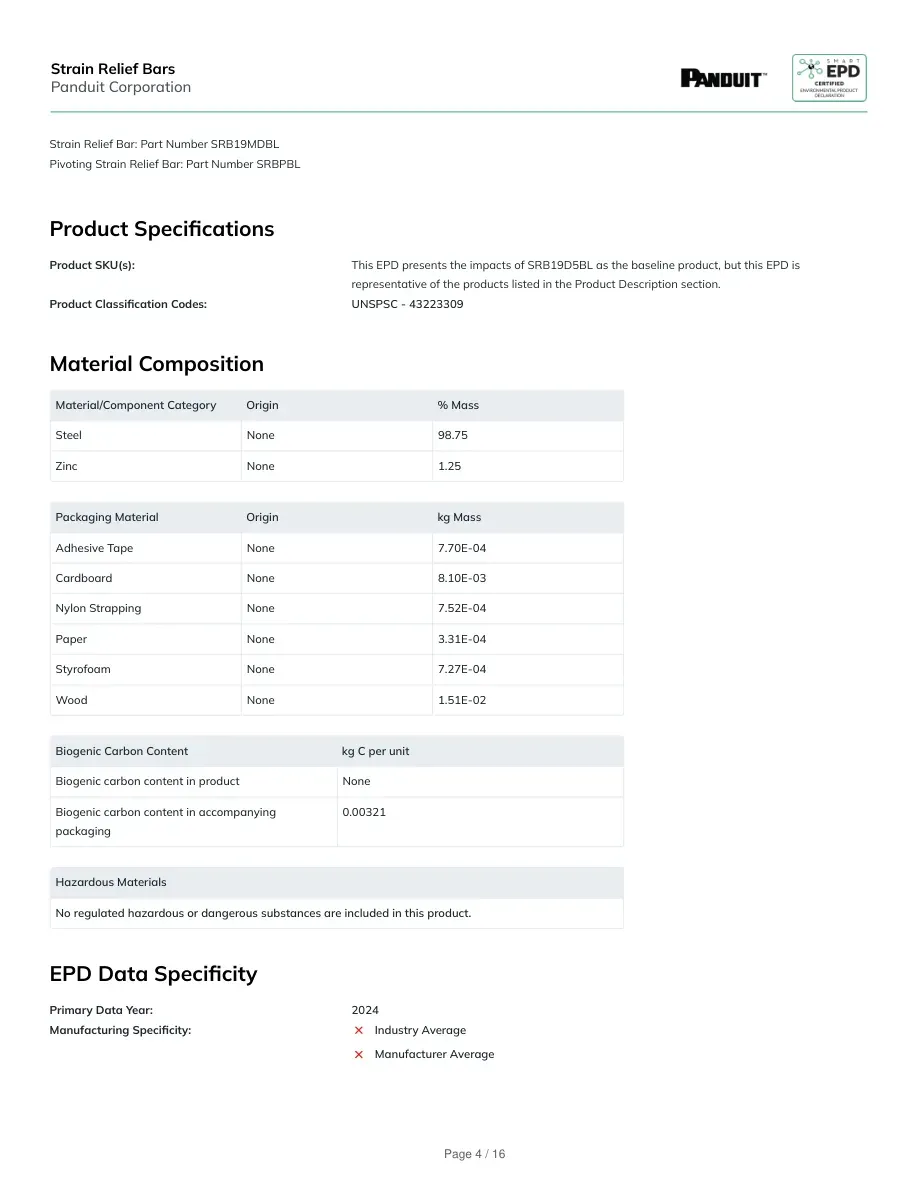
Strain Relief Bar: Part Number SRB19MDBLPivoting Strain Relief Bar: Part Number SRBPBLProduct SpecificationsProduct SKU(s):This EPD presents the impacts of SRB19D5BL as the baseline product, but this EPD isrepresentative of the products listed in the Product Description section.Product Classification Codes:UNSPSC - 43223309Material CompositionMaterial/Component CategoryOrigin% MassSteelNone98.75ZincNone1.25Packaging MaterialOriginkg MassAdhesive TapeNone7.70E-04CardboardNone8.10E-03Nylon StrappingNone7.52E-04PaperNone3.31E-04StyrofoamNone7.27E-04WoodNone1.51E-02Biogenic Carbon Contentkg C per unitBiogenic carbon content in productNoneBiogenic carbon content in accompanyingpackaging0.00321Hazardous MaterialsNo regulated hazardous or dangerous substances are included in this product.EPD Data SpecificityPrimary Data Year:2024Manufacturing Specificity:Industry AverageManufacturer AverageStrain Relief BarsPanduit CorporationPage 4 / 16
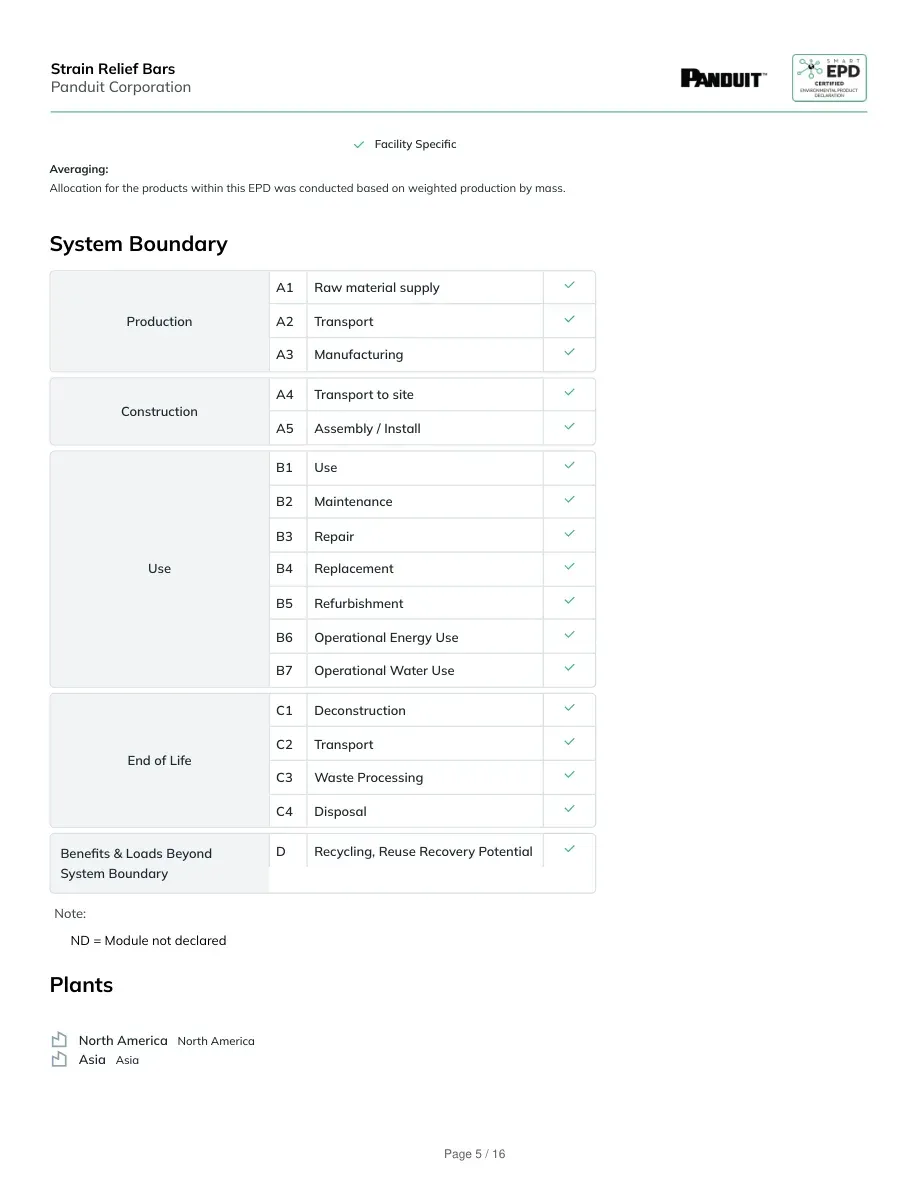
Facility SpecificAveraging:Allocation for the products within this EPD was conducted based on weighted production by mass.System BoundaryProductionA1Raw material supplyA2TransportA3ManufacturingConstructionA4Transport to siteA5Assembly / InstallUseB1UseB2MaintenanceB3RepairB4ReplacementB5RefurbishmentB6Operational Energy UseB7Operational Water UseEnd of LifeC1DeconstructionC2TransportC3Waste ProcessingC4DisposalBenefits & Loads BeyondSystem BoundaryDRecycling, Reuse Recovery PotentialNote:ND = Module not declaredPlantsNorth AmericaNorth AmericaAsiaAsiaStrain Relief BarsPanduit CorporationPage 5 / 16
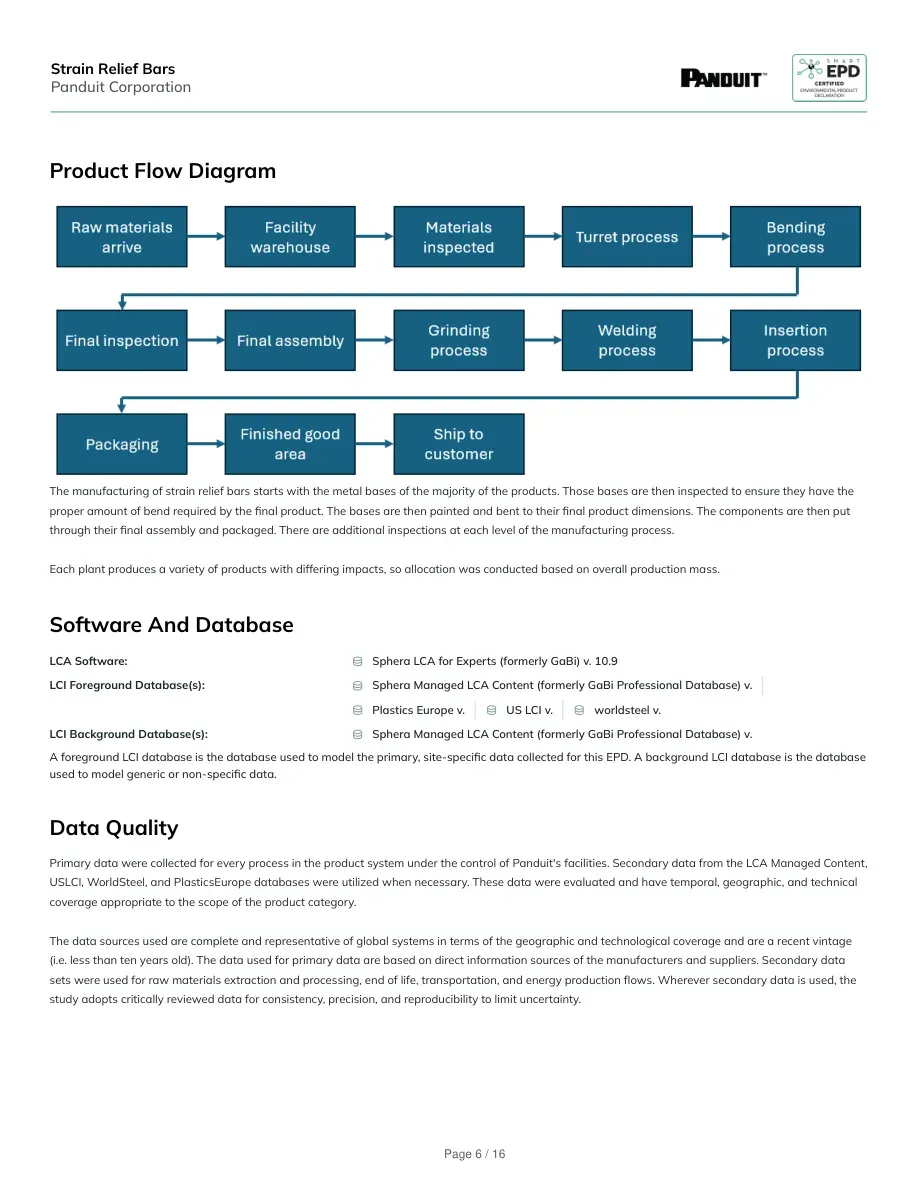
Product Flow DiagramThe manufacturing of strain relief bars starts with the metal bases of the majority of the products. Those bases are then inspected to ensure they have theproper amount of bend required by the final product. The bases are then painted and bent to their final product dimensions. The components are then putthrough their final assembly and packaged. There are additional inspections at each level of the manufacturing process.Each plant produces a variety of products with differing impacts, so allocation was conducted based on overall production mass.Software And DatabaseLCA Software:Sphera LCA for Experts (formerly GaBi) v. 10.9LCI Foreground Database(s):Sphera Managed LCA Content (formerly GaBi Professional Database) v.Plastics Europe v.US LCI v.worldsteel v.LCI Background Database(s):Sphera Managed LCA Content (formerly GaBi Professional Database) v.A foreground LCI database is the database used to model the primary, site-specific data collected for this EPD. A background LCI database is the databaseused to model generic or non-specific data.Data QualityPrimary data were collected for every process in the product system under the control of Panduit's facilities. Secondary data from the LCA Managed Content,USLCI, WorldSteel, and PlasticsEurope databases were utilized when necessary. These data were evaluated and have temporal, geographic, and technicalcoverage appropriate to the scope of the product category.The data sources used are complete and representative of global systems in terms of the geographic and technological coverage and are a recent vintage(i.e. less than ten years old). The data used for primary data are based on direct information sources of the manufacturers and suppliers. Secondary datasets were used for raw materials extraction and processing, end of life, transportation, and energy production flows. Wherever secondary data is used, thestudy adopts critically reviewed data for consistency, precision, and reproducibility to limit uncertainty.Strain Relief BarsPanduit CorporationPage 6 / 16
Life Cycle Module DescriptionThe primary manufacturing processes occur in multiple locations across North America and Asia. All manufacturing sites that produce the part numbers thatare included in this EPD product grouping are included in this scope.The scope of this EPD is cradle-to-grave and includes the life cycle stages of Raw Material Extraction and Processing, Raw Material Shipping,Manufacturing, Product Shipping, Packaging, Use, and Final Disposal.LCA DiscussionAllocation ProcedureThe LCI data was collected from the Panduit facilities for the 2024 calendar year. Allocation was determined on a per product basis for primary data. Forsecondary data, cut-off methodology was used.Cut-off ProcedureProcesses whose total contribution to the final result, with respect to their mass and in relation to all considered impact categories, is less than 1% can beneglected.The sum of the neglected processes may not exceed 5% by mass of the considered impact categories. For that a documented assumption is admissible.For Hazardous Substances the following requirements apply:• The Life Cycle Inventory (LCI) of hazardous substances will be included, if the inventory is available.• If the LCI for a hazardous substance is not available, the substance will appear as an input in the LCI of the product, if its mass represents more than 0.1%of theproduct composition.• If the LCI of a hazardous substance is approximated by modeling another substance, documentation will be provided.This EPD is in compliance with the cut-off criteria. No processes were neglected or excluded. Capital items for the production processes (machine, buildings,etc.) werenot taken into consideration.Renewable ElectricityEnergy Attribute Certificates (EACs) such asRenewable Energy Certificates (RECs) or PowerPurchase Agreements (PPAs) are included in thebaseline reported results:NoStrain Relief BarsPanduit CorporationPage 7 / 16
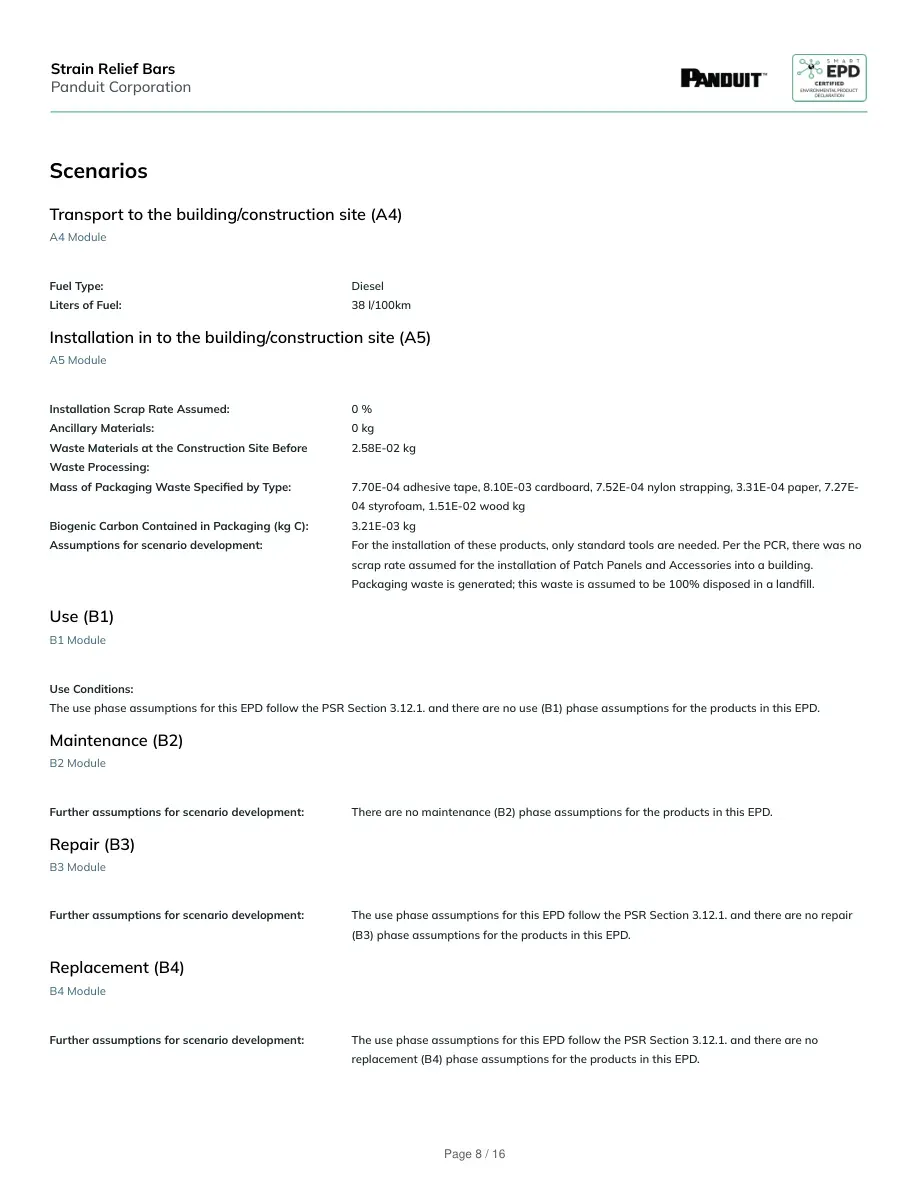
ScenariosTransport to the building/construction site (A4)A4 ModuleFuel Type:DieselLiters of Fuel:38 l/100kmInstallation in to the building/construction site (A5)A5 ModuleInstallation Scrap Rate Assumed:0 %Ancillary Materials:0 kgWaste Materials at the Construction Site BeforeWaste Processing:2.58E-02 kgMass of Packaging Waste Specified by Type:7.70E-04 adhesive tape, 8.10E-03 cardboard, 7.52E-04 nylon strapping, 3.31E-04 paper, 7.27E-04 styrofoam, 1.51E-02 wood kgBiogenic Carbon Contained in Packaging (kg C):3.21E-03 kgAssumptions for scenario development:For the installation of these products, only standard tools are needed. Per the PCR, there was noscrap rate assumed for the installation of Patch Panels and Accessories into a building.Packaging waste is generated; this waste is assumed to be 100% disposed in a landfill.Use (B1)B1 ModuleUse Conditions:The use phase assumptions for this EPD follow the PSR Section 3.12.1. and there are no use (B1) phase assumptions for the products in this EPD.Maintenance (B2)B2 ModuleFurther assumptions for scenario development:There are no maintenance (B2) phase assumptions for the products in this EPD.Repair (B3)B3 ModuleFurther assumptions for scenario development:The use phase assumptions for this EPD follow the PSR Section 3.12.1. and there are no repair(B3) phase assumptions for the products in this EPD.Replacement (B4)B4 ModuleFurther assumptions for scenario development:The use phase assumptions for this EPD follow the PSR Section 3.12.1. and there are noreplacement (B4) phase assumptions for the products in this EPD.Strain Relief BarsPanduit CorporationPage 8 / 16
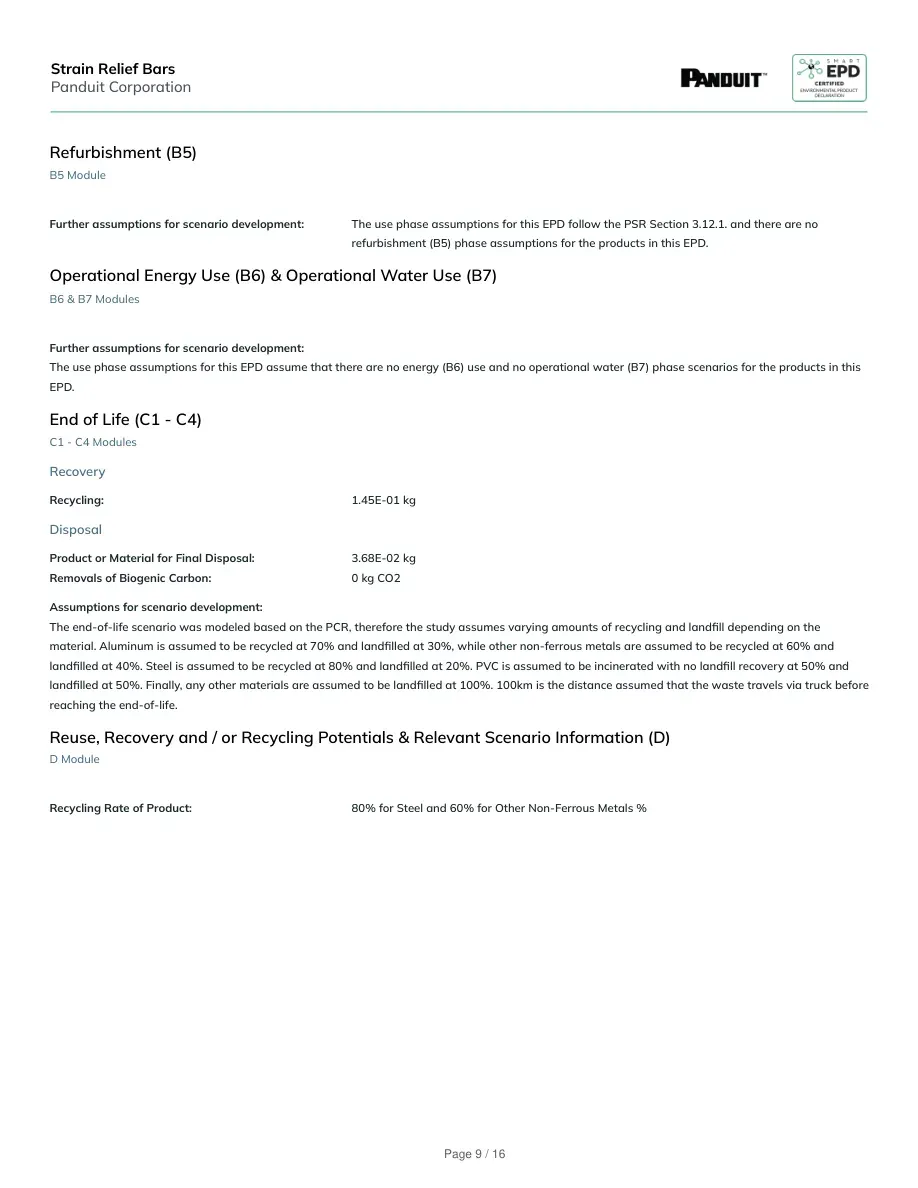
Refurbishment (B5)B5 ModuleFurther assumptions for scenario development:The use phase assumptions for this EPD follow the PSR Section 3.12.1. and there are norefurbishment (B5) phase assumptions for the products in this EPD.Operational Energy Use (B6) & Operational Water Use (B7)B6 & B7 ModulesFurther assumptions for scenario development:The use phase assumptions for this EPD assume that there are no energy (B6) use and no operational water (B7) phase scenarios for the products in thisEPD.End of Life (C1 - C4)C1 - C4 ModulesRecoveryRecycling:1.45E-01 kgDisposalProduct or Material for Final Disposal:3.68E-02 kgRemovals of Biogenic Carbon:0 kg CO2Assumptions for scenario development:The end-of-life scenario was modeled based on the PCR, therefore the study assumes varying amounts of recycling and landfill depending on thematerial. Aluminum is assumed to be recycled at 70% and landfilled at 30%, while other non-ferrous metals are assumed to be recycled at 60% andlandfilled at 40%. Steel is assumed to be recycled at 80% and landfilled at 20%. PVC is assumed to be incinerated with no landfill recovery at 50% andlandfilled at 50%. Finally, any other materials are assumed to be landfilled at 100%. 100km is the distance assumed that the waste travels via truck beforereaching the end-of-life.Reuse, Recovery and / or Recycling Potentials & Relevant Scenario Information (D)D ModuleRecycling Rate of Product:80% for Steel and 60% for Other Non-Ferrous Metals %Strain Relief BarsPanduit CorporationPage 9 / 16
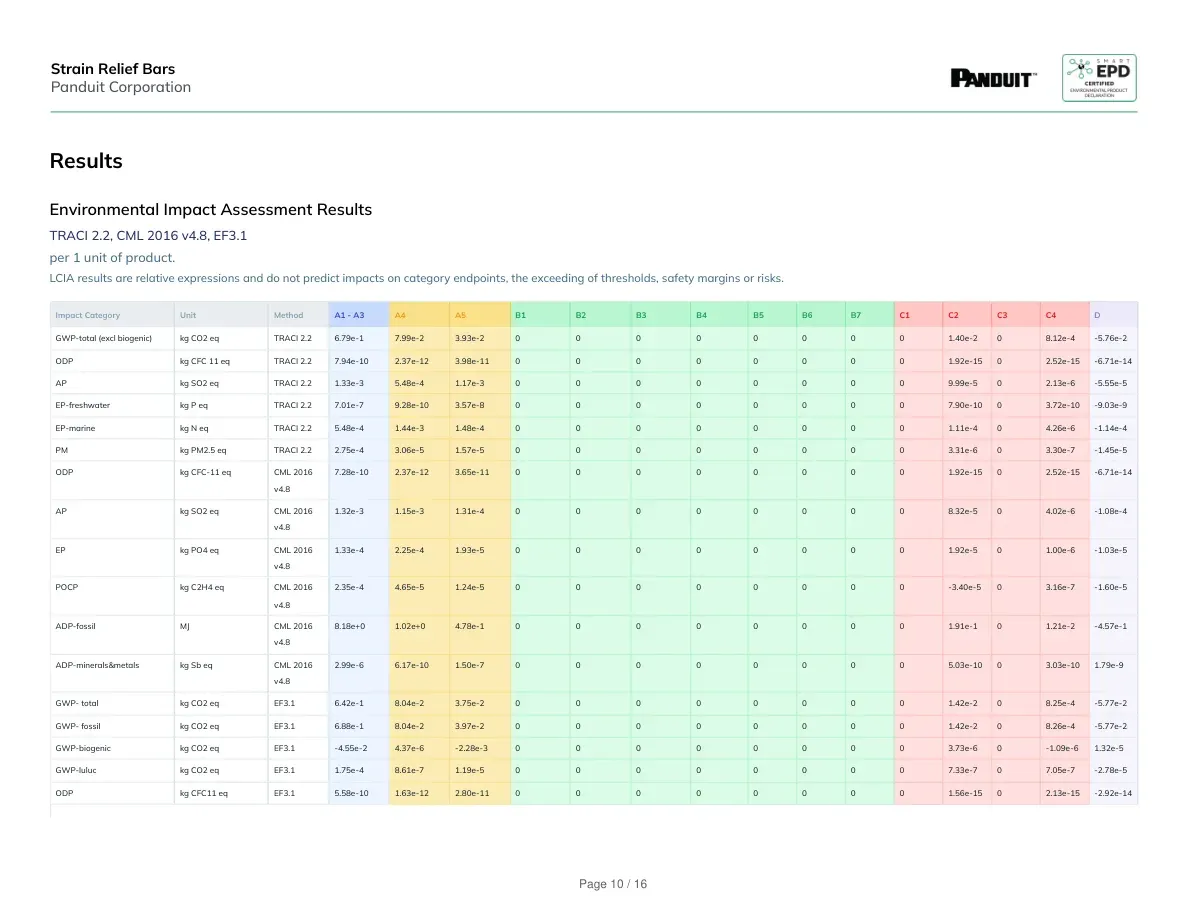
ResultsEnvironmental Impact Assessment ResultsTRACI 2.2, CML 2016 v4.8, EF3.1per 1 unit of product.LCIA results are relative expressions and do not predict impacts on category endpoints, the exceeding of thresholds, safety margins or risks.Impact CategoryUnitMethodA1 - A3A4A5B1B2B3B4B5B6B7C1C2C3C4DGWP-total (excl biogenic)kg CO2 eqTRACI 2.26.79e-17.99e-23.93e-2000000001.40e-208.12e-4-5.76e-2ODPkg CFC 11 eqTRACI 2.27.94e-102.37e-123.98e-11000000001.92e-1502.52e-15-6.71e-14APkg SO2 eqTRACI 2.21.33e-35.48e-41.17e-3000000009.99e-502.13e-6-5.55e-5EP-freshwaterkg P eqTRACI 2.27.01e-79.28e-103.57e-8000000007.90e-1003.72e-10-9.03e-9EP-marinekg N eqTRACI 2.25.48e-41.44e-31.48e-4000000001.11e-404.26e-6-1.14e-4PMkg PM2.5 eqTRACI 2.22.75e-43.06e-51.57e-5000000003.31e-603.30e-7-1.45e-5ODPkg CFC-11 eqCML 2016v4.87.28e-102.37e-123.65e-11000000001.92e-1502.52e-15-6.71e-14APkg SO2 eqCML 2016v4.81.32e-31.15e-31.31e-4000000008.32e-504.02e-6-1.08e-4EPkg PO4 eqCML 2016v4.81.33e-42.25e-41.93e-5000000001.92e-501.00e-6-1.03e-5POCPkg C2H4 eqCML 2016v4.82.35e-44.65e-51.24e-500000000-3.40e-503.16e-7-1.60e-5ADP-fossilMJCML 2016v4.88.18e+01.02e+04.78e-1000000001.91e-101.21e-2-4.57e-1ADP-minerals&metalskg Sb eqCML 2016v4.82.99e-66.17e-101.50e-7000000005.03e-1003.03e-101.79e-9GWP- totalkg CO2 eqEF3.16.42e-18.04e-23.75e-2000000001.42e-208.25e-4-5.77e-2GWP- fossilkg CO2 eqEF3.16.88e-18.04e-23.97e-2000000001.42e-208.26e-4-5.77e-2GWP-biogenickg CO2 eqEF3.1-4.55e-24.37e-6-2.28e-3000000003.73e-60-1.09e-61.32e-5GWP-luluckg CO2 eqEF3.11.75e-48.61e-71.19e-5000000007.33e-707.05e-7-2.78e-5ODPkg CFC11 eqEF3.15.58e-101.63e-122.80e-11000000001.56e-1502.13e-15-2.92e-14Strain Relief BarsPanduit CorporationPage 10 / 16
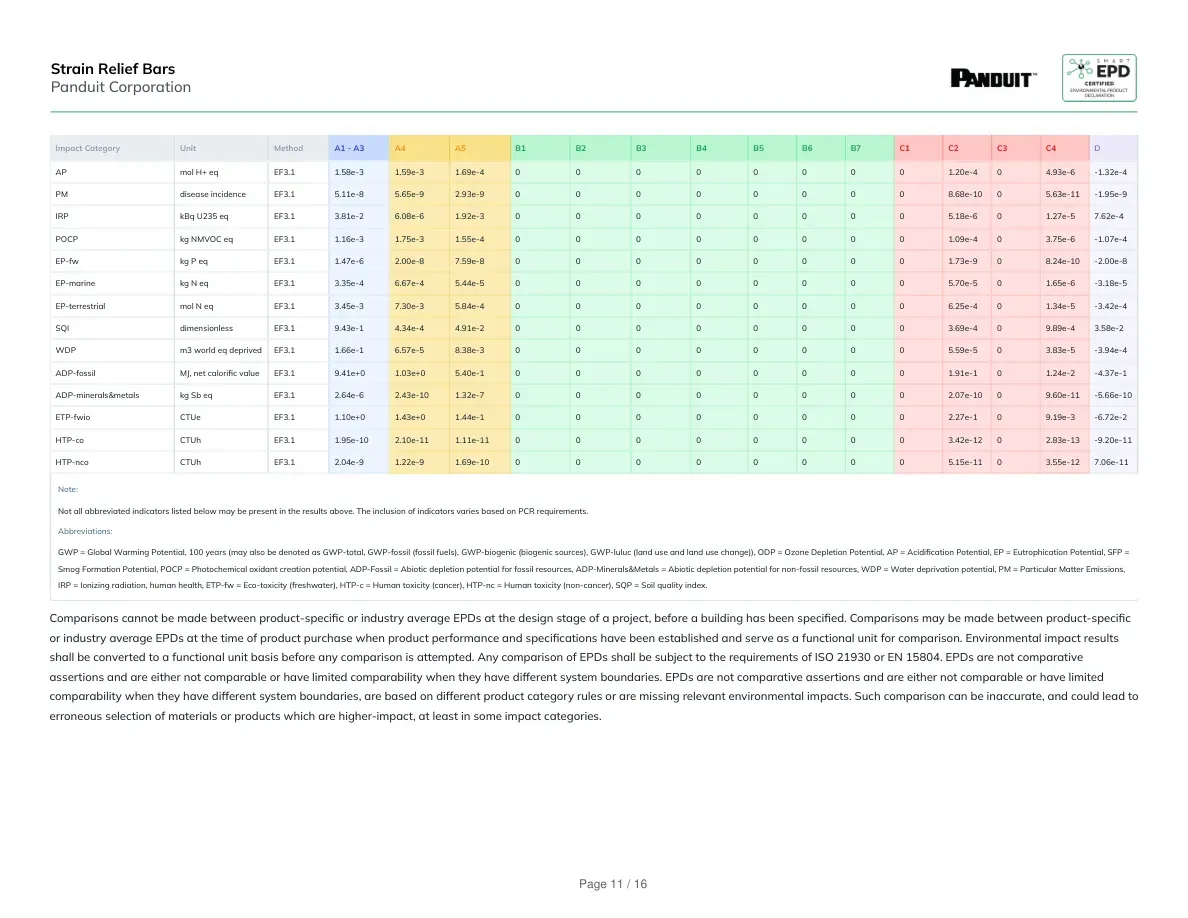
Impact CategoryUnitMethodA1 - A3A4A5B1B2B3B4B5B6B7C1C2C3C4DAPmol H+ eqEF3.11.58e-31.59e-31.69e-4000000001.20e-404.93e-6-1.32e-4PMdisease incidenceEF3.15.11e-85.65e-92.93e-9000000008.68e-1005.63e-11-1.95e-9IRPkBq U235 eqEF3.13.81e-26.08e-61.92e-3000000005.18e-601.27e-57.62e-4POCPkg NMVOC eqEF3.11.16e-31.75e-31.55e-4000000001.09e-403.75e-6-1.07e-4EP-fwkg P eqEF3.11.47e-62.00e-87.59e-8000000001.73e-908.24e-10-2.00e-8EP-marinekg N eqEF3.13.35e-46.67e-45.44e-5000000005.70e-501.65e-6-3.18e-5EP-terrestrialmol N eqEF3.13.45e-37.30e-35.84e-4000000006.25e-401.34e-5-3.42e-4SQIdimensionlessEF3.19.43e-14.34e-44.91e-2000000003.69e-409.89e-43.58e-2WDPm3 world eq deprivedEF3.11.66e-16.57e-58.38e-3000000005.59e-503.83e-5-3.94e-4ADP-fossilMJ, net calorific valueEF3.19.41e+01.03e+05.40e-1000000001.91e-101.24e-2-4.37e-1ADP-minerals&metalskg Sb eqEF3.12.64e-62.43e-101.32e-7000000002.07e-1009.60e-11-5.66e-10ETP-fwioCTUeEF3.11.10e+01.43e+01.44e-1000000002.27e-109.19e-3-6.72e-2HTP-coCTUhEF3.11.95e-102.10e-111.11e-11000000003.42e-1202.83e-13-9.20e-11HTP-ncoCTUhEF3.12.04e-91.22e-91.69e-10000000005.15e-1103.55e-127.06e-11Note:Not all abbreviated indicators listed below may be present in the results above. The inclusion of indicators varies based on PCR requirements.Abbreviations:GWP = Global Warming Potential, 100 years (may also be denoted as GWP-total, GWP-fossil (fossil fuels), GWP-biogenic (biogenic sources), GWP-luluc (land use and land use change)), ODP = Ozone Depletion Potential, AP = Acidification Potential, EP = Eutrophication Potential, SFP =Smog Formation Potential, POCP = Photochemical oxidant creation potential, ADP-Fossil = Abiotic depletion potential for fossil resources, ADP-Minerals&Metals = Abiotic depletion potential for non-fossil resources, WDP = Water deprivation potential, PM = Particular Matter Emissions,IRP = Ionizing radiation, human health, ETP-fw = Eco-toxicity (freshwater), HTP-c = Human toxicity (cancer), HTP-nc = Human toxicity (non-cancer), SQP = Soil quality index.Comparisons cannot be made between product-specific or industry average EPDs at the design stage of a project, before a building has been specified. Comparisons may be made between product-specificor industry average EPDs at the time of product purchase when product performance and specifications have been established and serve as a functional unit for comparison. Environmental impact resultsshall be converted to a functional unit basis before any comparison is attempted. Any comparison of EPDs shall be subject to the requirements of ISO 21930 or EN 15804. EPDs are not comparativeassertions and are either not comparable or have limited comparability when they have different system boundaries. EPDs are not comparative assertions and are either not comparable or have limitedcomparability when they have different system boundaries, are based on different product category rules or are missing relevant environmental impacts. Such comparison can be inaccurate, and could lead toerroneous selection of materials or products which are higher-impact, at least in some impact categories.Strain Relief BarsPanduit CorporationPage 11 / 16
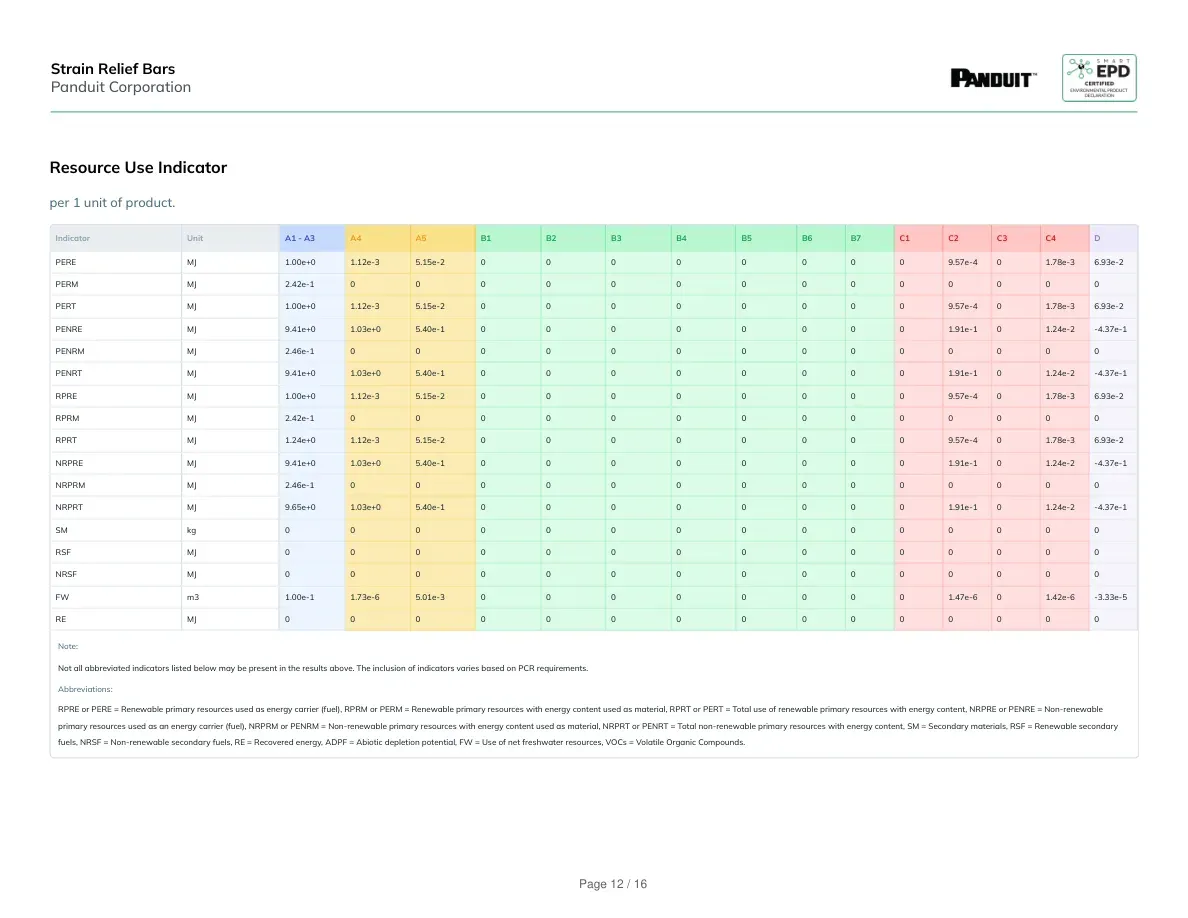
Resource Use Indicatorper 1 unit of product.IndicatorUnitA1 - A3A4A5B1B2B3B4B5B6B7C1C2C3C4DPEREMJ1.00e+01.12e-35.15e-2000000009.57e-401.78e-36.93e-2PERMMJ2.42e-100000000000000PERTMJ1.00e+01.12e-35.15e-2000000009.57e-401.78e-36.93e-2PENREMJ9.41e+01.03e+05.40e-1000000001.91e-101.24e-2-4.37e-1PENRMMJ2.46e-100000000000000PENRTMJ9.41e+01.03e+05.40e-1000000001.91e-101.24e-2-4.37e-1RPREMJ1.00e+01.12e-35.15e-2000000009.57e-401.78e-36.93e-2RPRMMJ2.42e-100000000000000RPRTMJ1.24e+01.12e-35.15e-2000000009.57e-401.78e-36.93e-2NRPREMJ9.41e+01.03e+05.40e-1000000001.91e-101.24e-2-4.37e-1NRPRMMJ2.46e-100000000000000NRPRTMJ9.65e+01.03e+05.40e-1000000001.91e-101.24e-2-4.37e-1SMkg000000000000000RSFMJ000000000000000NRSFMJ000000000000000FWm31.00e-11.73e-65.01e-3000000001.47e-601.42e-6-3.33e-5REMJ000000000000000Note:Not all abbreviated indicators listed below may be present in the results above. The inclusion of indicators varies based on PCR requirements.Abbreviations:RPRE or PERE = Renewable primary resources used as energy carrier (fuel), RPRM or PERM = Renewable primary resources with energy content used as material, RPRT or PERT = Total use of renewable primary resources with energy content, NRPRE or PENRE = Non-renewableprimary resources used as an energy carrier (fuel), NRPRM or PENRM = Non-renewable primary resources with energy content used as material, NRPRT or PENRT = Total non-renewable primary resources with energy content, SM = Secondary materials, RSF = Renewable secondaryfuels, NRSF = Non-renewable secondary fuels, RE = Recovered energy, ADPF = Abiotic depletion potential, FW = Use of net freshwater resources, VOCs = Volatile Organic Compounds.Strain Relief BarsPanduit CorporationPage 12 / 16
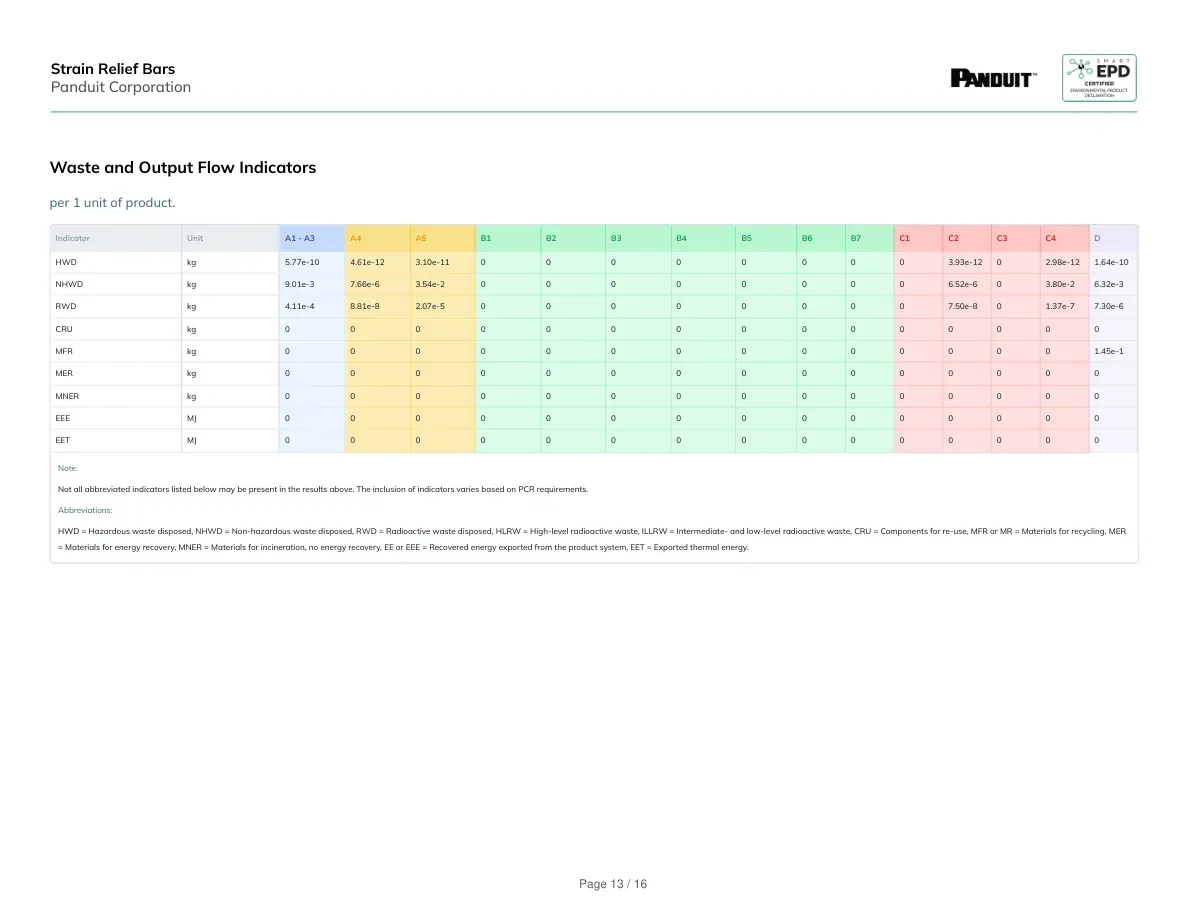
Waste and Output Flow Indicatorsper 1 unit of product.IndicatorUnitA1 - A3A4A5B1B2B3B4B5B6B7C1C2C3C4DHWDkg5.77e-104.61e-123.10e-11000000003.93e-1202.98e-121.64e-10NHWDkg9.01e-37.66e-63.54e-2000000006.52e-603.80e-26.32e-3RWDkg4.11e-48.81e-82.07e-5000000007.50e-801.37e-77.30e-6CRUkg000000000000000MFRkg000000000000001.45e-1MERkg000000000000000MNERkg000000000000000EEEMJ000000000000000EETMJ000000000000000Note:Not all abbreviated indicators listed below may be present in the results above. The inclusion of indicators varies based on PCR requirements.Abbreviations:HWD = Hazardous waste disposed, NHWD = Non-hazardous waste disposed, RWD = Radioactive waste disposed, HLRW = High-level radioactive waste, ILLRW = Intermediate- and low-level radioactive waste, CRU = Components for re-use, MFR or MR = Materials for recycling, MER= Materials for energy recovery, MNER = Materials for incineration, no energy recovery, EE or EEE = Recovered energy exported from the product system, EET = Exported thermal energy.Strain Relief BarsPanduit CorporationPage 13 / 16
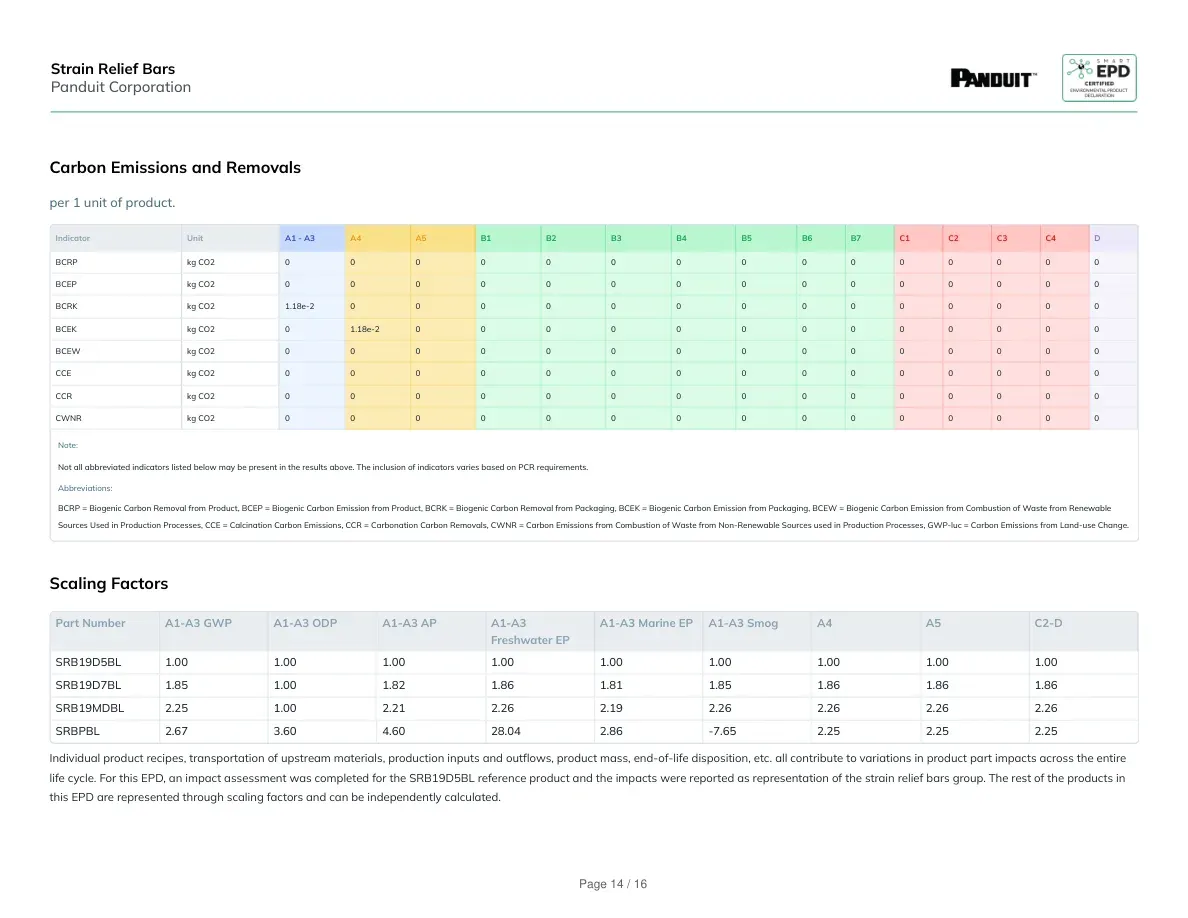
Carbon Emissions and Removalsper 1 unit of product.IndicatorUnitA1 - A3A4A5B1B2B3B4B5B6B7C1C2C3C4DBCRPkg CO2000000000000000BCEPkg CO2000000000000000BCRKkg CO21.18e-200000000000000BCEKkg CO201.18e-20000000000000BCEWkg CO2000000000000000CCEkg CO2000000000000000CCRkg CO2000000000000000CWNRkg CO2000000000000000Note:Not all abbreviated indicators listed below may be present in the results above. The inclusion of indicators varies based on PCR requirements.Abbreviations:BCRP = Biogenic Carbon Removal from Product, BCEP = Biogenic Carbon Emission from Product, BCRK = Biogenic Carbon Removal from Packaging, BCEK = Biogenic Carbon Emission from Packaging, BCEW = Biogenic Carbon Emission from Combustion of Waste from RenewableSources Used in Production Processes, CCE = Calcination Carbon Emissions, CCR = Carbonation Carbon Removals, CWNR = Carbon Emissions from Combustion of Waste from Non-Renewable Sources used in Production Processes, GWP-luc = Carbon Emissions from Land-use Change.Scaling FactorsPart NumberA1-A3 GWPA1-A3 ODPA1-A3 APA1-A3Freshwater EPA1-A3 Marine EPA1-A3 SmogA4A5C2-DSRB19D5BL1.001.001.001.001.001.001.001.001.00SRB19D7BL1.851.001.821.861.811.851.861.861.86SRB19MDBL2.251.002.212.262.192.262.262.262.26SRBPBL2.673.604.6028.042.86-7.652.252.252.25Individual product recipes, transportation of upstream materials, production inputs and outflows, product mass, end-of-life disposition, etc. all contribute to variations in product part impacts across the entirelife cycle. For this EPD, an impact assessment was completed for the SRB19D5BL reference product and the impacts were reported as representation of the strain relief bars group. The rest of the products inthis EPD are represented through scaling factors and can be independently calculated.Strain Relief BarsPanduit CorporationPage 14 / 16
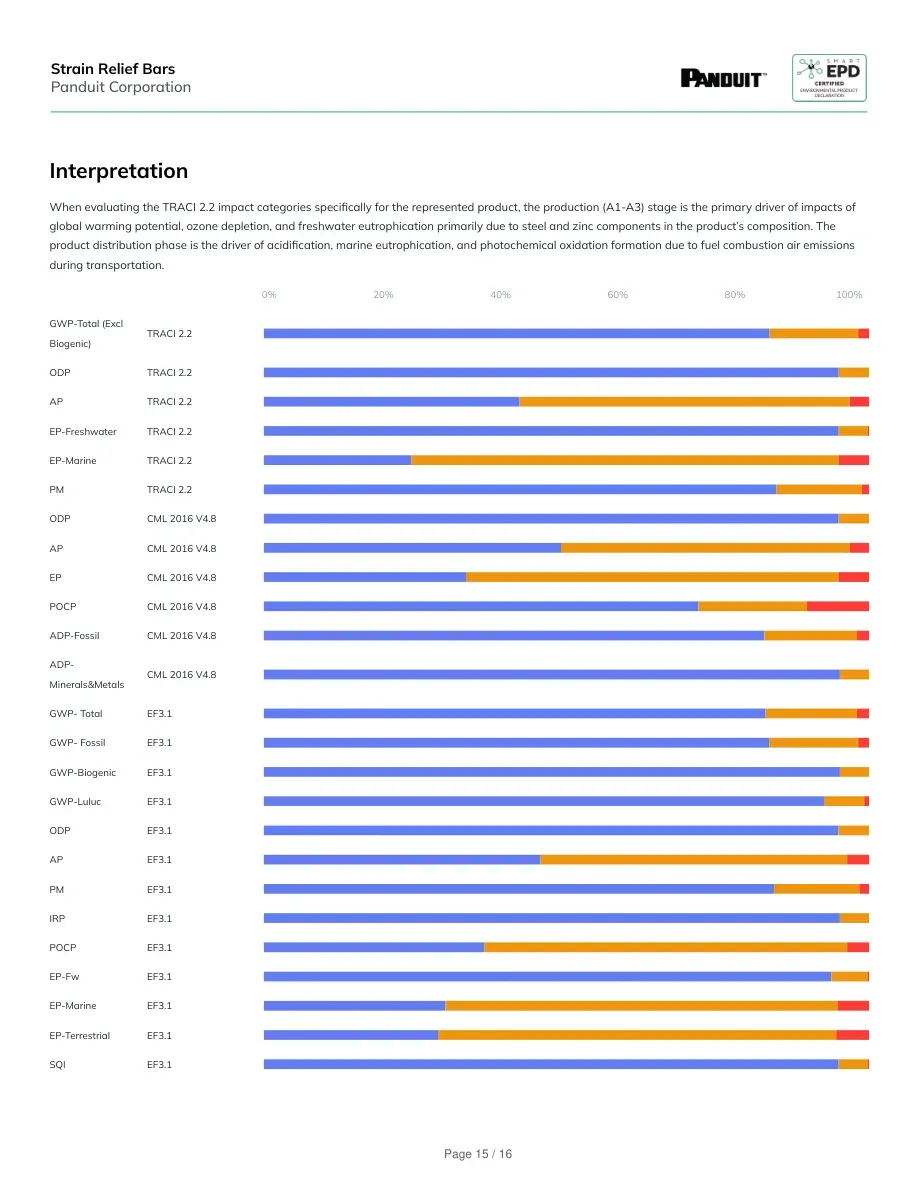
InterpretationWhen evaluating the TRACI 2.2 impact categories specifically for the represented product, the production (A1-A3) stage is the primary driver of impacts ofglobal warming potential, ozone depletion, and freshwater eutrophication primarily due to steel and zinc components in the product’s composition. Theproduct distribution phase is the driver of acidification, marine eutrophication, and photochemical oxidation formation due to fuel combustion air emissionsduring transportation.0%20%40%60%80%100%GWP-Total (ExclBiogenic)TRACI 2.2ODPTRACI 2.2APTRACI 2.2EP-FreshwaterTRACI 2.2EP-MarineTRACI 2.2PMTRACI 2.2ODPCML 2016 V4.8APCML 2016 V4.8EPCML 2016 V4.8POCPCML 2016 V4.8ADP-FossilCML 2016 V4.8ADP-Minerals&MetalsCML 2016 V4.8GWP- TotalEF3.1GWP- FossilEF3.1GWP-BiogenicEF3.1GWP-LulucEF3.1ODPEF3.1APEF3.1PMEF3.1IRPEF3.1POCPEF3.1EP-FwEF3.1EP-MarineEF3.1EP-TerrestrialEF3.1SQIEF3.1Strain Relief BarsPanduit CorporationPage 15 / 16
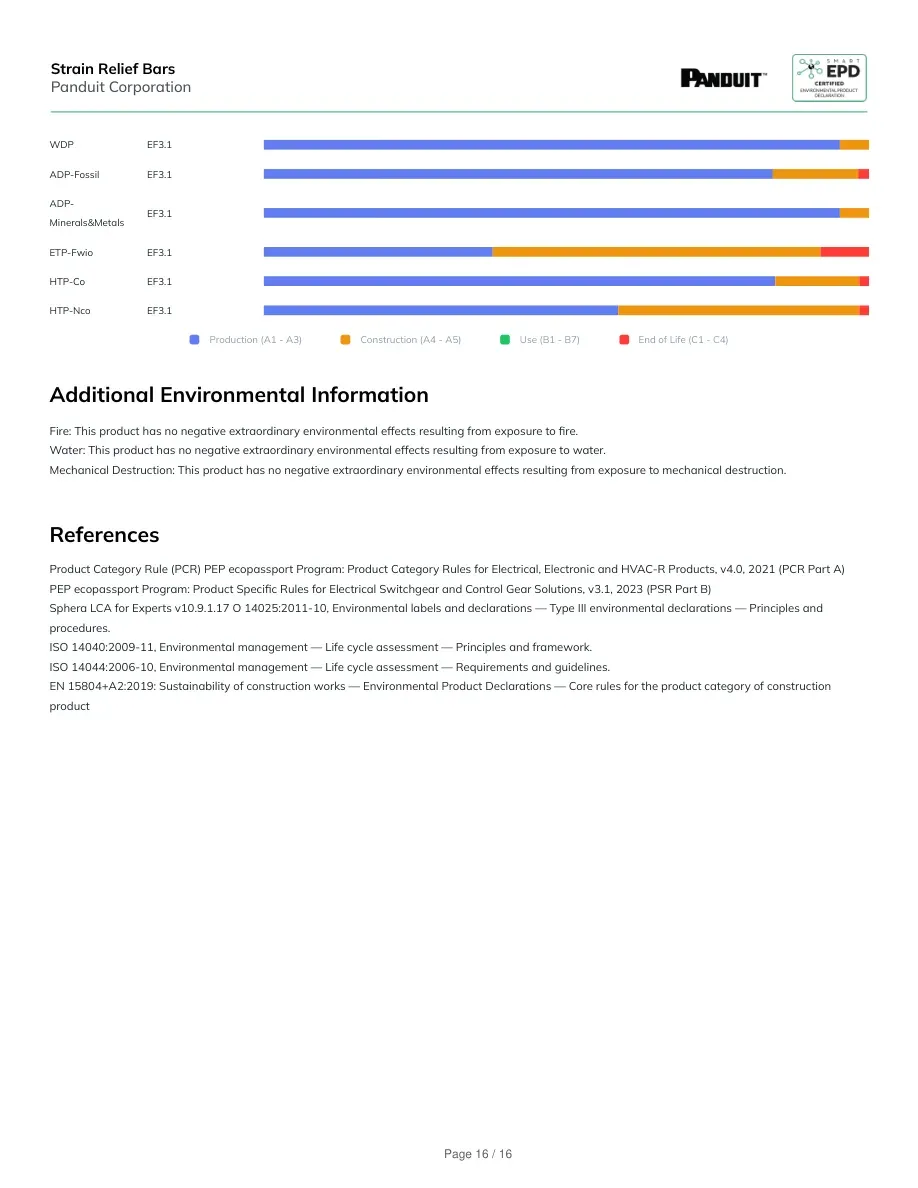
WDPEF3.1ADP-FossilEF3.1ADP-Minerals&MetalsEF3.1ETP-FwioEF3.1HTP-CoEF3.1HTP-NcoEF3.1Production (A1 - A3)Construction (A4 - A5)Use (B1 - B7)End of Life (C1 - C4)Additional Environmental InformationFire: This product has no negative extraordinary environmental effects resulting from exposure to fire.Water: This product has no negative extraordinary environmental effects resulting from exposure to water.Mechanical Destruction: This product has no negative extraordinary environmental effects resulting from exposure to mechanical destruction.ReferencesProduct Category Rule (PCR) PEP ecopassport Program: Product Category Rules for Electrical, Electronic and HVAC-R Products, v4.0, 2021 (PCR Part A)PEP ecopassport Program: Product Specific Rules for Electrical Switchgear and Control Gear Solutions, v3.1, 2023 (PSR Part B)Sphera LCA for Experts v10.9.1.17 O 14025:2011-10, Environmental labels and declarations — Type III environmental declarations — Principles andprocedures.ISO 14040:2009-11, Environmental management — Life cycle assessment — Principles and framework.ISO 14044:2006-10, Environmental management — Life cycle assessment — Requirements and guidelines.EN 15804+A2:2019: Sustainability of construction works — Environmental Product Declarations — Core rules for the product category of constructionproductStrain Relief BarsPanduit CorporationPage 16 / 16