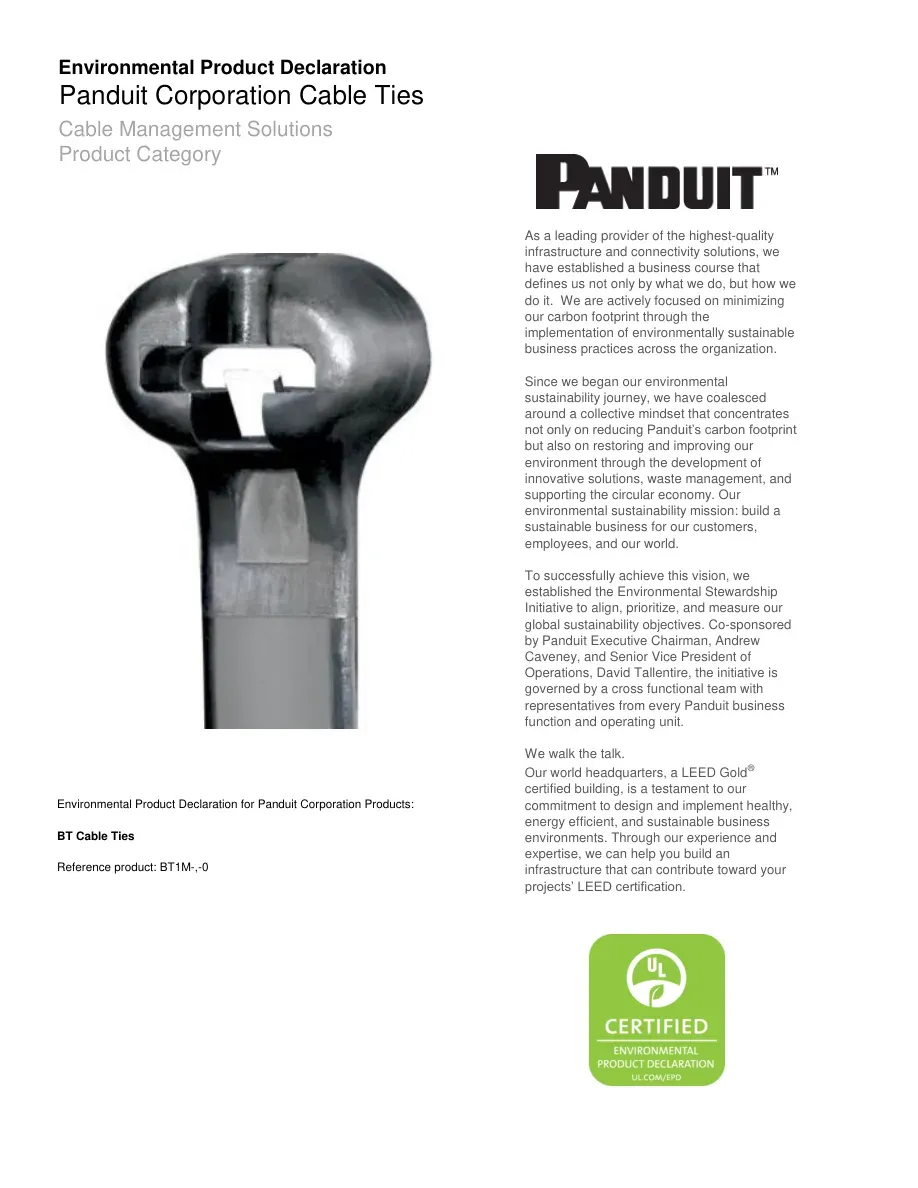
Cable Management Solutions Product CategoryAs a leading provider of the highest-quality infrastructure and connectivity solutions, we have established a business course that defines us not only by what we do, but how we do it. We are actively focused on minimizing our carbon footprint through the implementation of environmentally sustainable business practices across the organization.Since we began our environmental sustainability journey, we have coalesced around a collective mindset that concentrates not only on reducing Panduit’s carbon footprint but also on restoring and improving our environment through the development of innovative solutions, waste management, and supporting the circular economy. Our environmental sustainability mission: build a sustainable business for our customers, employees, and our world.To successfully achieve this vision, we established the Environmental Stewardship Initiative to align, prioritize, and measure our global sustainability objectives. Co-sponsored by Panduit Executive Chairman, Andrew Caveney, and Senior Vice President of Operations, David Tallentire, the initiative is governed by a cross functional team with representatives from every Panduit business function and operating unit.We walk the talk.Our world headquarters, a LEED Gold® certified building, is a testament to our commitment to design and implement healthy, energy efficient, and sustainable business environments. Through our experience and expertise, we can help you build an infrastructure that can contribute toward your projects’ LEED certification.Environmental Product DeclarationPanduit Corporation Cable TiesEnvironmental Product Declaration for Panduit Corporation Products:BT Cable TiesReference product: BT1M-,-0
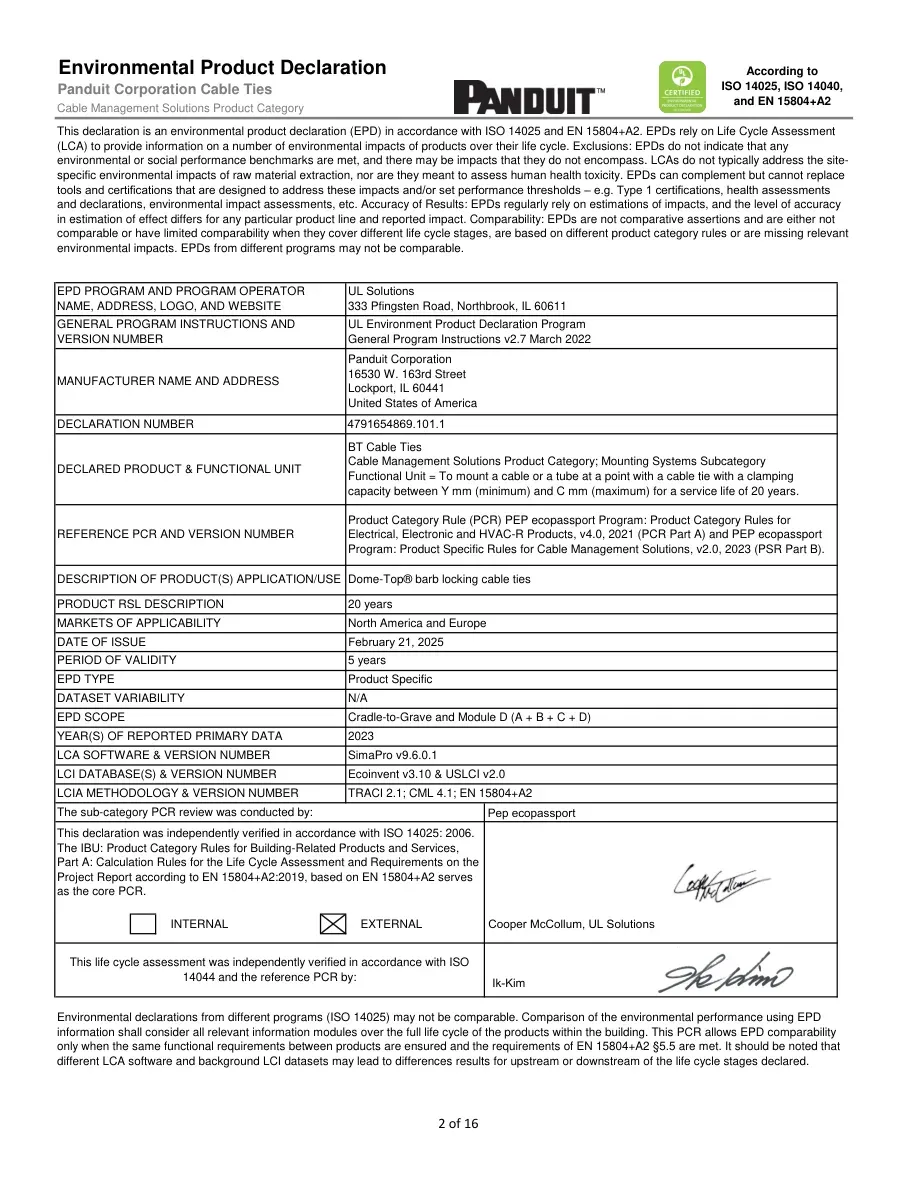
INTERNALEXTERNALYEAR(S) OF REPORTED PRIMARY DATA2023LCA SOFTWARE & VERSION NUMBERProduct Category Rule (PCR) PEP ecopassport Program: Product Category Rules for Electrical, Electronic and HVAC-R Products, v4.0, 2021 (PCR Part A) and PEP ecopassport Program: Product Specific Rules for Cable Management Solutions, v2.0, 2023 (PSR Part B).DECLARATION NUMBERNorth America and EuropeDATE OF ISSUE20 yearsEPD SCOPECradle-to-Grave and Module D (A + B + C + D)PRODUCT RSL DESCRIPTIONMANUFACTURER NAME AND ADDRESSPanduit Corporation16530 W. 163rd StreetLockport, IL 60441United States of AmericaPanduit Corporation Cable TiesThis declaration is an environmental product declaration (EPD) in accordance with ISO 14025 and EN 15804+A2. EPDs rely on Life Cycle Assessment (LCA) to provide information on a number of environmental impacts of products over their life cycle. Exclusions: EPDs do not indicate that any environmental or social performance benchmarks are met, and there may be impacts that they do not encompass. LCAs do not typically address the site-specific environmental impacts of raw material extraction, nor are they meant to assess human health toxicity. EPDs can complement but cannot replace tools and certifications that are designed to address these impacts and/or set performance thresholds – e.g. Type 1 certifications, health assessments and declarations, environmental impact assessments, etc. Accuracy of Results: EPDs regularly rely on estimations of impacts, and the level of accuracy in estimation of effect differs for any particular product line and reported impact. Comparability: EPDs are not comparative assertions and are either not comparable or have limited comparability when they cover different life cycle stages, are based on different product category rules or are missing relevant environmental impacts. EPDs from different programs may not be comparable.EPD PROGRAM AND PROGRAM OPERATOR NAME, ADDRESS, LOGO, AND WEBSITEAccording toISO 14025, ISO 14040,and EN 15804+A2Environmental declarations from different programs (ISO 14025) may not be comparable. Comparison of the environmental performance using EPD information shall consider all relevant information modules over the full life cycle of the products within the building. This PCR allows EPD comparability only when the same functional requirements between products are ensured and the requirements of EN 15804+A2 §5.5 are met. It should be noted that different LCA software and background LCI datasets may lead to differences results for upstream or downstream of the life cycle stages declared.GENERAL PROGRAM INSTRUCTIONS AND VERSION NUMBERThis life cycle assessment was independently verified in accordance with ISO 14044 and the reference PCR by:UL Environment Product Declaration ProgramGeneral Program Instructions v2.7 March 2022Cable Management Solutions Product CategoryThe sub-category PCR review was conducted by:DECLARED PRODUCT & FUNCTIONAL UNITBT Cable TiesCable Management Solutions Product Category; Mounting Systems SubcategoryFunctional Unit = To mount a cable or a tube at a point with a cable tie with a clamping capacity between Y mm (minimum) and C mm (maximum) for a service life of 20 years.DESCRIPTION OF PRODUCT(S) APPLICATION/USE Dome-Top® barb locking cable tiesSimaPro v9.6.0.1LCIA METHODOLOGY & VERSION NUMBERTRACI 2.1; CML 4.1; EN 15804+A2REFERENCE PCR AND VERSION NUMBERPERIOD OF VALIDITY5 yearsEPD TYPEProduct SpecificDATASET VARIABILITYN/ALCI DATABASE(S) & VERSION NUMBEREcoinvent v3.10 & USLCI v2.0UL Solutions333 Pfingsten Road, Northbrook, IL 60611This declaration was independently verified in accordance with ISO 14025: 2006. The IBU: Product Category Rules for Building-Related Products and Services, Part A: Calculation Rules for the Life Cycle Assessment and Requirements on the Project Report according to EN 15804+A2:2019, based on EN 15804+A2 serves as the core PCR.Environmental Product DeclarationMARKETS OF APPLICABILITY2 of 164791654869.101.1February 21, 2025Pep ecopassport Cooper McCollum, UL SolutionsIk-Kim
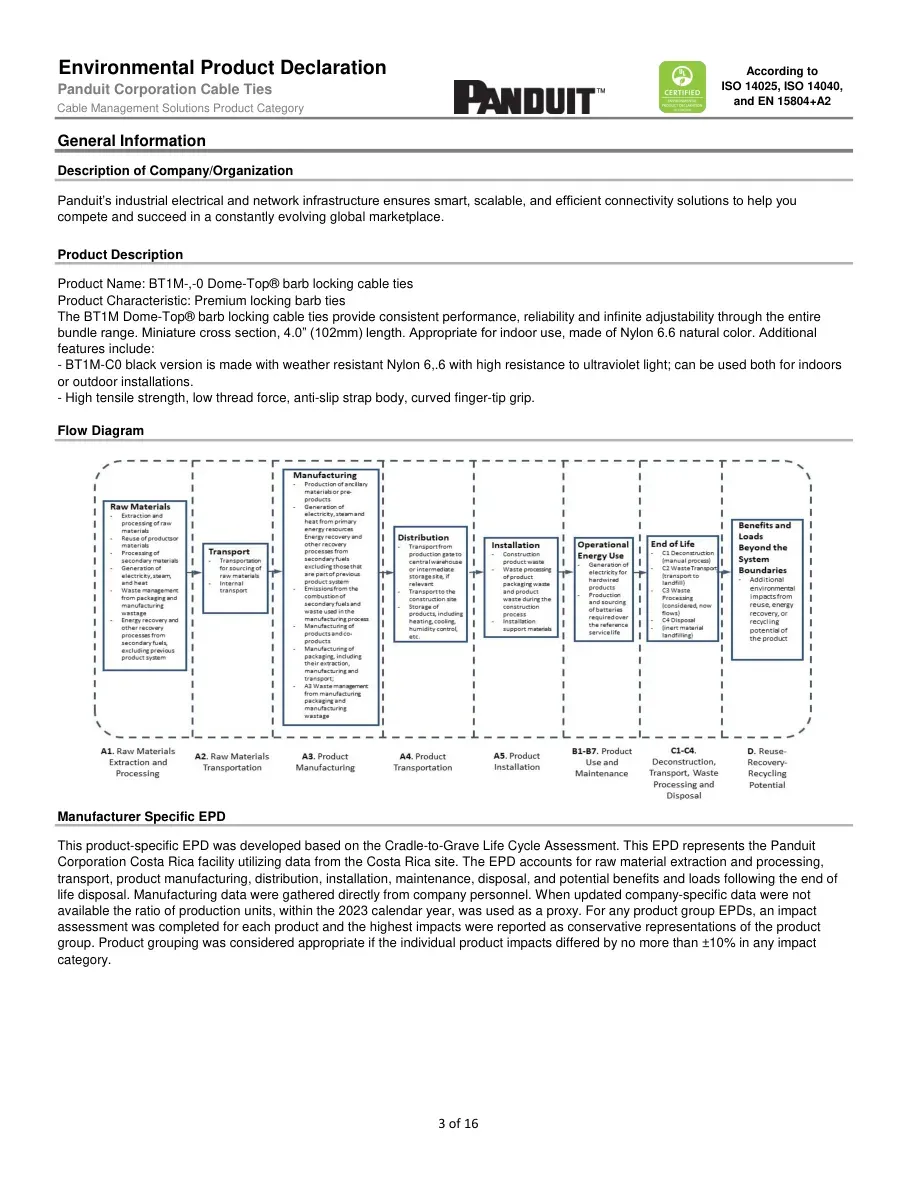
Panduit Corporation Cable TiesAccording toISO 14025, ISO 14040,and EN 15804+A2Cable Management Solutions Product CategoryEnvironmental Product DeclarationProduct Name: BT1M-,-0 Dome-Top® barb locking cable tiesProduct Characteristic: Premium locking barb tiesThe BT1M Dome-Top® barb locking cable ties provide consistent performance, reliability and infinite adjustability through the entire bundle range. Miniature cross section, 4.0” (102mm) length. Appropriate for indoor use, made of Nylon 6.6 natural color. Additional features include: - BT1M-C0 black version is made with weather resistant Nylon 6,.6 with high resistance to ultraviolet light; can be used both for indoorsor outdoor installations.- High tensile strength, low thread force, anti-slip strap body, curved finger-tip grip.Product DescriptionThis product-specific EPD was developed based on the Cradle-to-Grave Life Cycle Assessment. This EPD represents the Panduit Corporation Costa Rica facility utilizing data from the Costa Rica site. The EPD accounts for raw material extraction and processing, transport, product manufacturing, distribution, installation, maintenance, disposal, and potential benefits and loads following the end of life disposal. Manufacturing data were gathered directly from company personnel. When updated company-specific data were not available the ratio of production units, within the 2023 calendar year, was used as a proxy. For any product group EPDs, an impact assessment was completed for each product and the highest impacts were reported as conservative representations of the product group. Product grouping was considered appropriate if the individual product impacts differed by no more than ±10% in any impact category.Flow DiagramManufacturer Specific EPDPanduit’s industrial electrical and network infrastructure ensures smart, scalable, and efficient connectivity solutions to help you compete and succeed in a constantly evolving global marketplace.Description of Company/OrganizationGeneral Information3 of 16
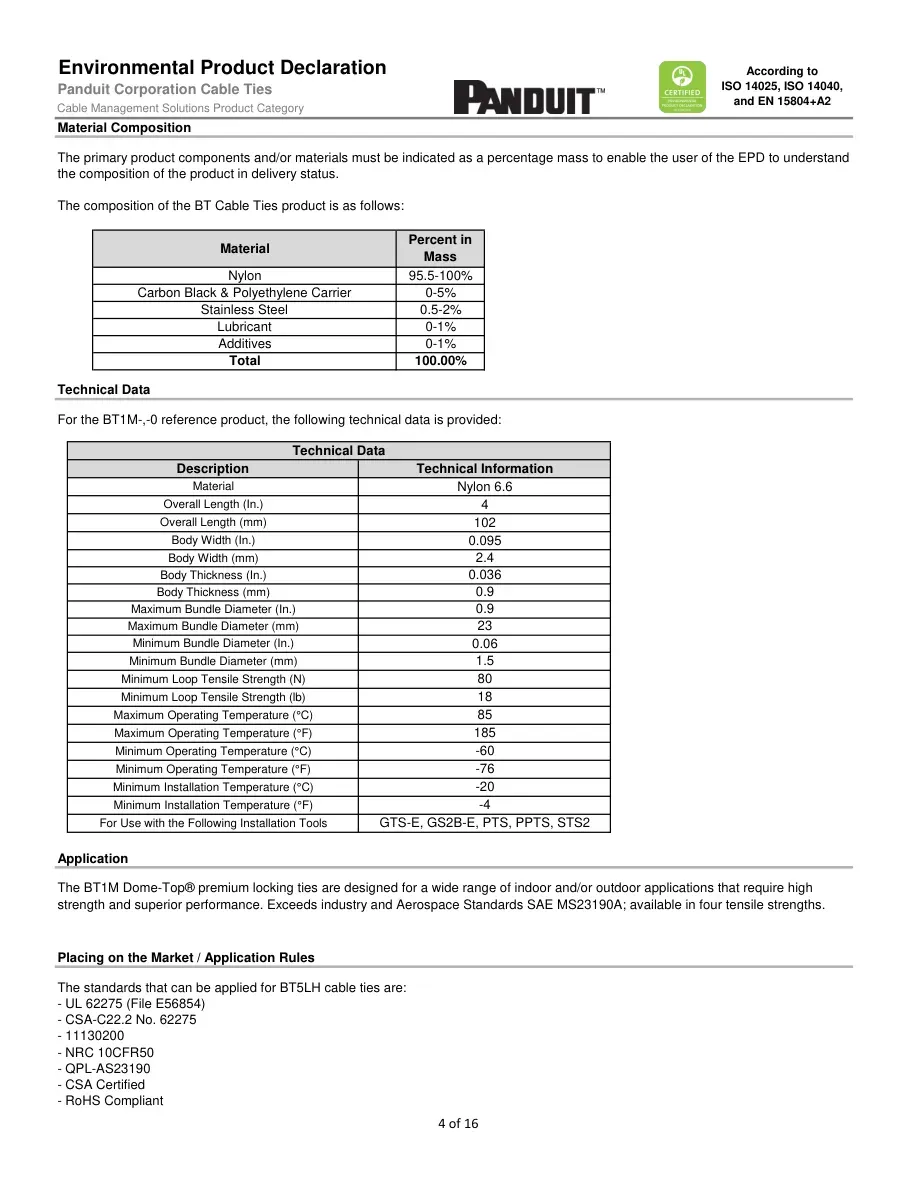
Panduit Corporation Cable TiesAccording toISO 14025, ISO 14040,and EN 15804+A2Cable Management Solutions Product CategoryEnvironmental Product Declaration0-1%Overall Length (In.)Technical Data100.00%LubricantAdditivesTotalMaterial CompositionThe primary product components and/or materials must be indicated as a percentage mass to enable the user of the EPD to understand the composition of the product in delivery status. The composition of the BT Cable Ties product is as follows:95.5-100%Percent in Mass0-5%0.5-2%MaterialNylonCarbon Black & Polyethylene CarrierStainless SteelFor the BT1M-,-0 reference product, the following technical data is provided:The standards that can be applied for BT5LH cable ties are: - UL 62275 (File E56854)- CSA-C22.2 No. 62275- 11130200- NRC 10CFR50- QPL-AS23190- CSA Certified- RoHS CompliantPlacing on the Market / Application RulesFor Use with the Following Installation ToolsDescriptionMaterialGTS-E, GS2B-E, PTS, PPTS, STS2Technical InformationNylon 6.641020.0952.40.0360.90.9230.061.51885185-60-76-20-40-1%Technical Data80ApplicationThe BT1M Dome-Top® premium locking ties are designed for a wide range of indoor and/or outdoor applications that require high strength and superior performance. Exceeds industry and Aerospace Standards SAE MS23190A; available in four tensile strengths.Overall Length (mm)Body Width (In.)Body Width (mm)Body Thickness (In.)Body Thickness (mm)Maximum Bundle Diameter (In.)Maximum Bundle Diameter (mm)Minimum Bundle Diameter (In.)Minimum Bundle Diameter (mm)Minimum Loop Tensile Strength (N)Minimum Loop Tensile Strength (lb)Maximum Operating Temperature (°C)Maximum Operating Temperature (°F)Minimum Operating Temperature (°C)Minimum Operating Temperature (°F)Minimum Installation Temperature (°C)Minimum Installation Temperature (°F) 4 of 16
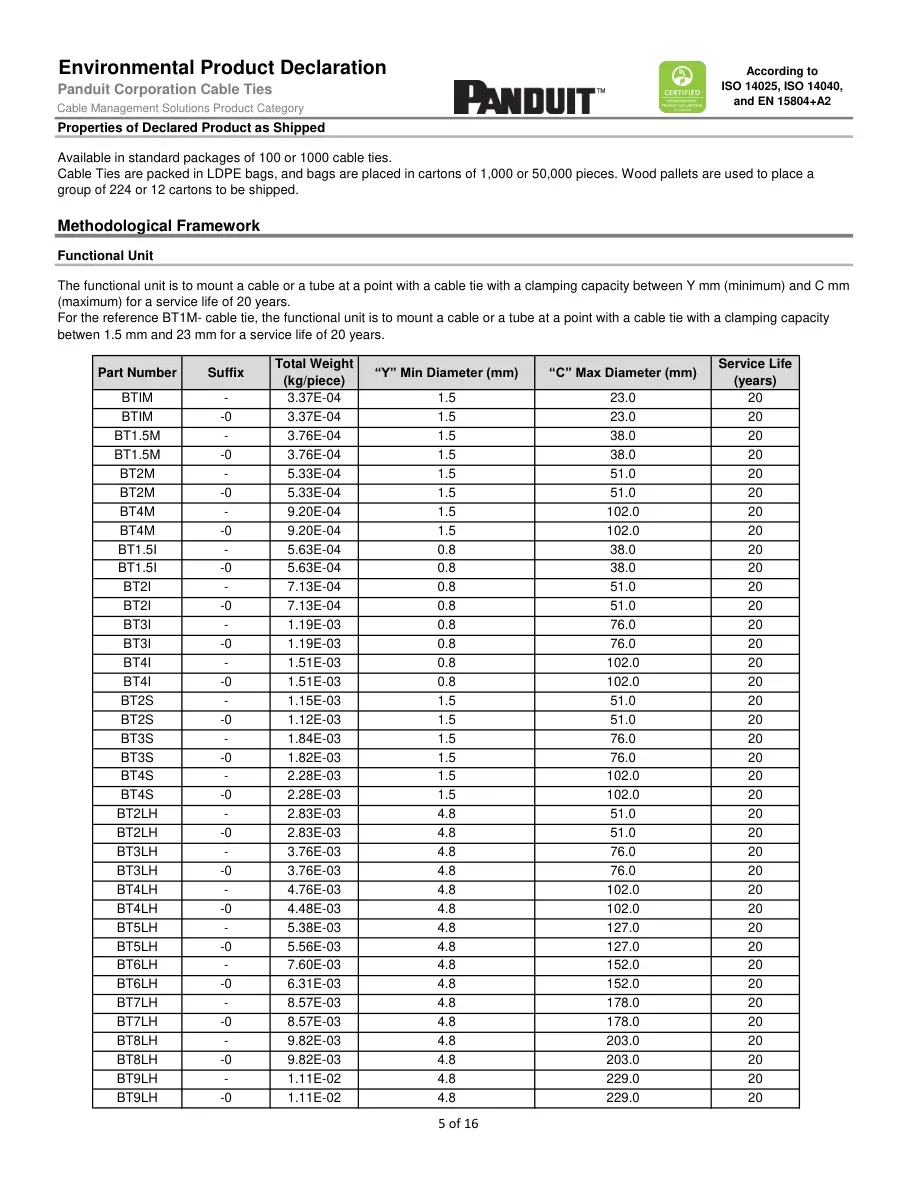
Panduit Corporation Cable TiesAccording toISO 14025, ISO 14040,and EN 15804+A2Cable Management Solutions Product CategoryEnvironmental Product Declaration152.0127.0127.0102.0102.076.076.0229.0229.0203.0Methodological Framework0.80.80.80.80.823.051.051.0102.0102.076.076.051.051.0102.0102.076.076.051.051.038.038.0102.0102.051.051.038.038.01.5“Y” Min Diameter (mm)“C” Max Diameter (mm)1.523.00.81.51.51.51.51.51.51.54.84.84.84.84.84.84.84.84.84.84.84.84.84.84.81.5203.0178.0178.0152.0Properties of Declared Product as ShippedThe functional unit is to mount a cable or a tube at a point with a cable tie with a clamping capacity between Y mm (minimum) and C mm (maximum) for a service life of 20 years.For the reference BT1M- cable tie, the functional unit is to mount a cable or a tube at a point with a cable tie with a clamping capacity betwen 1.5 mm and 23 mm for a service life of 20 years.BT5LHBT5LHBT6LHBT6LHBT7LHBT7LHBT8LHBT8LHAvailable in standard packages of 100 or 1000 cable ties. Cable Ties are packed in LDPE bags, and bags are placed in cartons of 1,000 or 50,000 pieces. Wood pallets are used to place a group of 224 or 12 cartons to be shipped.Functional UnitBT9LHBT9LHBT3SBT4SBT4SBT2LHBT2LHBT3LHBT3LHBT4LHBT4LH-0--0--0--0--0-2.28E-031.11E-021.11E-02-0--0--09.82E-03-0-Part NumberSuffixTotal Weight (kg/piece)Service Life (years)BTIMBTIMBT1.5MBT1.5MBT2MBT2MBT4MBT4MBT1.5IBT1.5IBT2IBT2IBT3IBT3IBT4IBT4IBT2SBT2SBT3S-0-1.12E-031.84E-031.82E-032.28E-03--0--0--0--0--0--0--0--0--03.37E-043.37E-043.76E-043.76E-045.33E-045.33E-049.20E-049.20E-045.63E-045.63E-047.13E-047.13E-041.19E-031.19E-031.51E-031.51E-031.15E-03-2.83E-032.83E-033.76E-033.76E-034.76E-034.48E-035.38E-035.56E-037.60E-036.31E-038.57E-038.57E-039.82E-032020202020202020201.51.51.54.8202020202020202020202020202020201.50.80.820202020202020202020202020 5 of 16
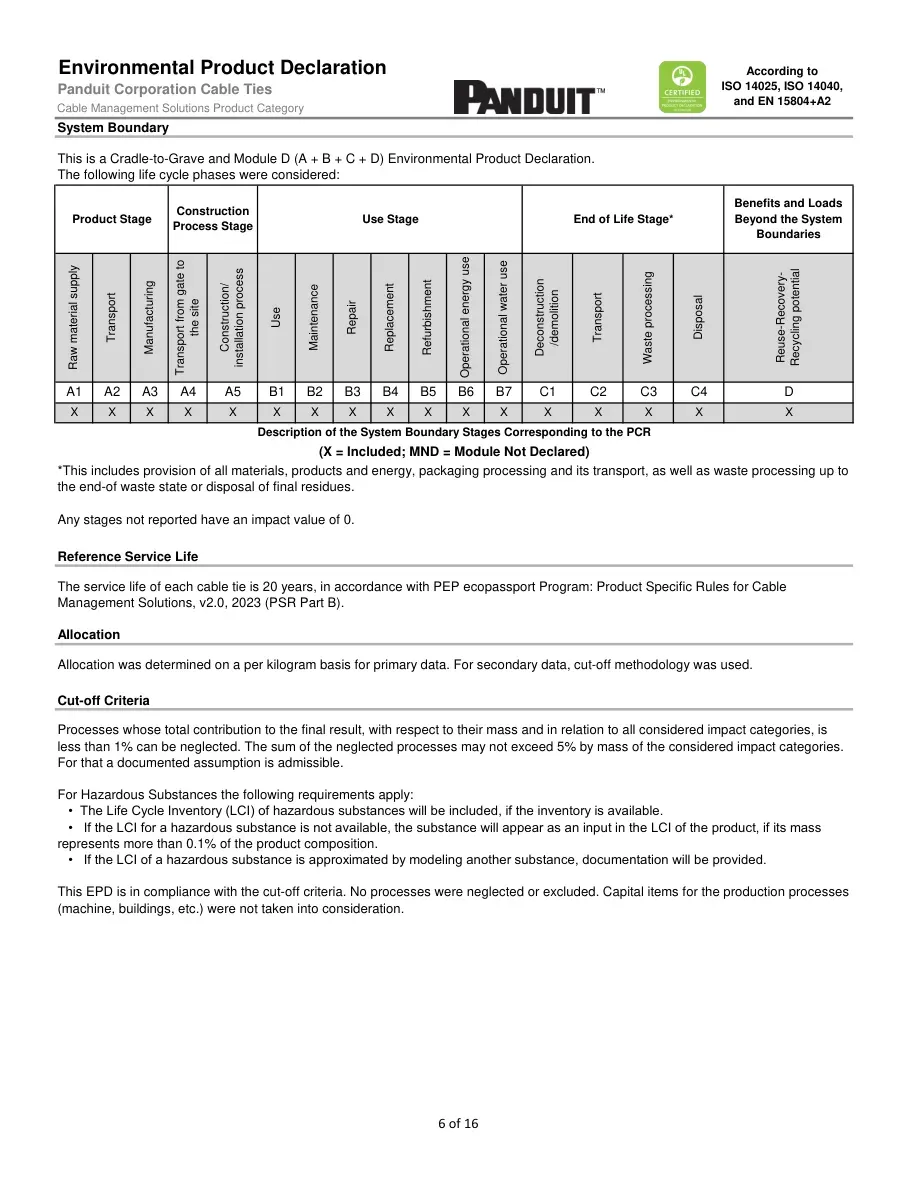
Panduit Corporation Cable TiesAccording toISO 14025, ISO 14040,and EN 15804+A2Cable Management Solutions Product CategoryEnvironmental Product DeclarationDescription of the System Boundary Stages Corresponding to the PCR(X = Included; MND = Module Not Declared)XCut-off CriteriaXA5XDXA2B1C1B5ReplacementXB2Transport from gate to the siteConstruction/ installation processXC2Processes whose total contribution to the final result, with respect to their mass and in relation to all considered impact categories, is less than 1% can be neglected. The sum of the neglected processes may not exceed 5% by mass of the considered impact categories. For that a documented assumption is admissible.For Hazardous Substances the following requirements apply: • The Life Cycle Inventory (LCI) of hazardous substances will be included, if the inventory is available. • If the LCI for a hazardous substance is not available, the substance will appear as an input in the LCI of the product, if its mass represents more than 0.1% of the product composition. • If the LCI of a hazardous substance is approximated by modeling another substance, documentation will be provided.This EPD is in compliance with the cut-off criteria. No processes were neglected or excluded. Capital items for the production processes (machine, buildings, etc.) were not taken into consideration.XProduct StageConstruction Process StageUse StageEnd of Life Stage*Raw material supplyTransportManufacturingAllocation was determined on a per kilogram basis for primary data. For secondary data, cut-off methodology was used.Operational energy useXXXB7A3XXRefurbishmentBenefits and Loads Beyond the System BoundariesUseXB6B4A4The service life of each cable tie is 20 years, in accordance with PEP ecopassport Program: Product Specific Rules for Cable Management Solutions, v2.0, 2023 (PSR Part B).C3C4Reference Service LifeXXB3Deconstruction /demolitionReuse-Recovery-Recycling potentialTransportA1This is a Cradle-to-Grave and Module D (A + B + C + D) Environmental Product Declaration. The following life cycle phases were considered:System BoundaryWaste processingDisposalRepairMaintenanceOperational water useX*This includes provision of all materials, products and energy, packaging processing and its transport, as well as waste processing up to the end-of waste state or disposal of final residues. Any stages not reported have an impact value of 0.XAllocation 6 of 16
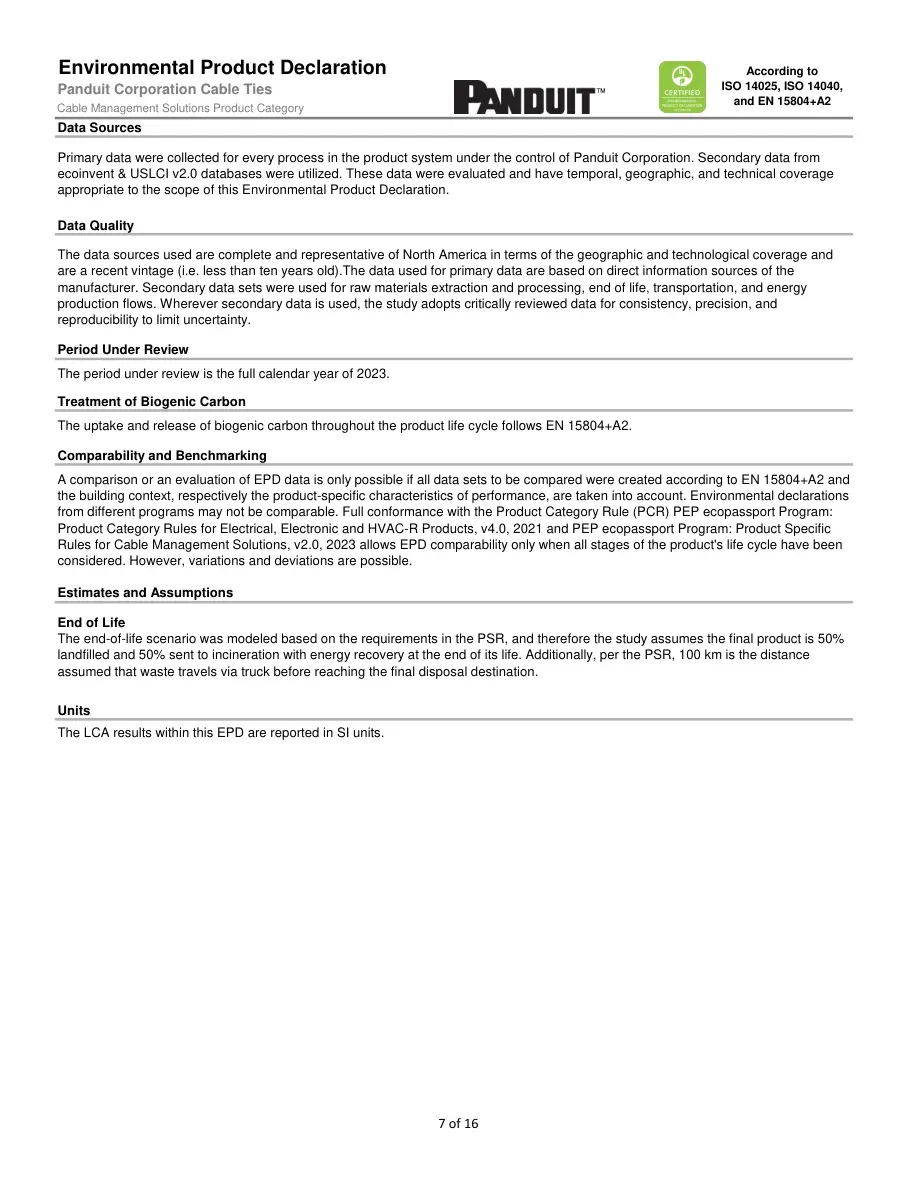
Panduit Corporation Cable TiesAccording toISO 14025, ISO 14040,and EN 15804+A2Cable Management Solutions Product CategoryEnvironmental Product DeclarationEstimates and AssumptionsPrimary data were collected for every process in the product system under the control of Panduit Corporation. Secondary data from ecoinvent & USLCI v2.0 databases were utilized. These data were evaluated and have temporal, geographic, and technical coverage appropriate to the scope of this Environmental Product Declaration.The end-of-life scenario was modeled based on the requirements in the PSR, and therefore the study assumes the final product is 50% landfilled and 50% sent to incineration with energy recovery at the end of its life. Additionally, per the PSR, 100 km is the distance assumed that waste travels via truck before reaching the final disposal destination.End of LifeThe period under review is the full calendar year of 2023.The data sources used are complete and representative of North America in terms of the geographic and technological coverage and are a recent vintage (i.e. less than ten years old).The data used for primary data are based on direct information sources of the manufacturer. Secondary data sets were used for raw materials extraction and processing, end of life, transportation, and energy production flows. Wherever secondary data is used, the study adopts critically reviewed data for consistency, precision, and reproducibility to limit uncertainty.The LCA results within this EPD are reported in SI units.Data SourcesUnitsThe uptake and release of biogenic carbon throughout the product life cycle follows EN 15804+A2.Treatment of Biogenic CarbonComparability and BenchmarkingData QualityA comparison or an evaluation of EPD data is only possible if all data sets to be compared were created according to EN 15804+A2 and the building context, respectively the product-specific characteristics of performance, are taken into account. Environmental declarations from different programs may not be comparable. Full conformance with the Product Category Rule (PCR) PEP ecopassport Program: Product Category Rules for Electrical, Electronic and HVAC-R Products, v4.0, 2021 and PEP ecopassport Program: Product Specific Rules for Cable Management Solutions, v2.0, 2023 allows EPD comparability only when all stages of the product's life cycle have been considered. However, variations and deviations are possible.Period Under Review 7 of 16
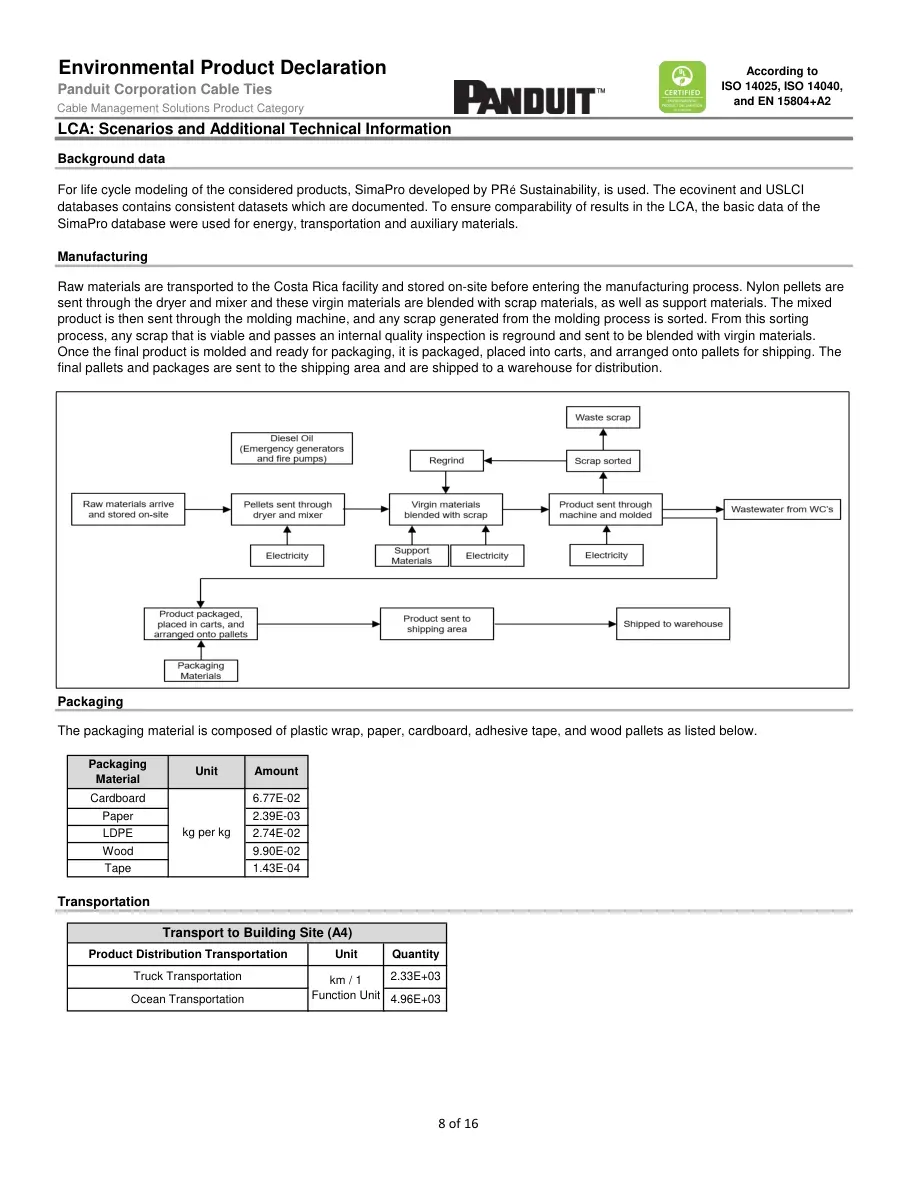
Panduit Corporation Cable TiesAccording toISO 14025, ISO 14040,and EN 15804+A2Cable Management Solutions Product CategoryEnvironmental Product DeclarationBackground data2.33E+034.96E+03LDPEWood2.74E-029.90E-02Tape6.77E-022.39E-031.43E-04kg per kgTransportationRaw materials are transported to the Costa Rica facility and stored on-site before entering the manufacturing process. Nylon pellets are sent through the dryer and mixer and these virgin materials are blended with scrap materials, as well as support materials. The mixed product is then sent through the molding machine, and any scrap generated from the molding process is sorted. From this sorting process, any scrap that is viable and passes an internal quality inspection is reground and sent to be blended with virgin materials. Once the final product is molded and ready for packaging, it is packaged, placed into carts, and arranged onto pallets for shipping. The final pallets and packages are sent to the shipping area and are shipped to a warehouse for distribution.LCA: Scenarios and Additional Technical InformationUnitUnitPackaging MaterialAmountQuantityCardboardPaperPackagingThe packaging material is composed of plastic wrap, paper, cardboard, adhesive tape, and wood pallets as listed below.Manufacturingkm / 1 Function UnitFor life cycle modeling of the considered products, SimaPro developed by PRé Sustainability, is used. The ecovinent and USLCI databases contains consistent datasets which are documented. To ensure comparability of results in the LCA, the basic data of the SimaPro database were used for energy, transportation and auxiliary materials.Product Distribution TransportationTruck Transportation Ocean TransportationTransport to Building Site (A4) 8 of 16
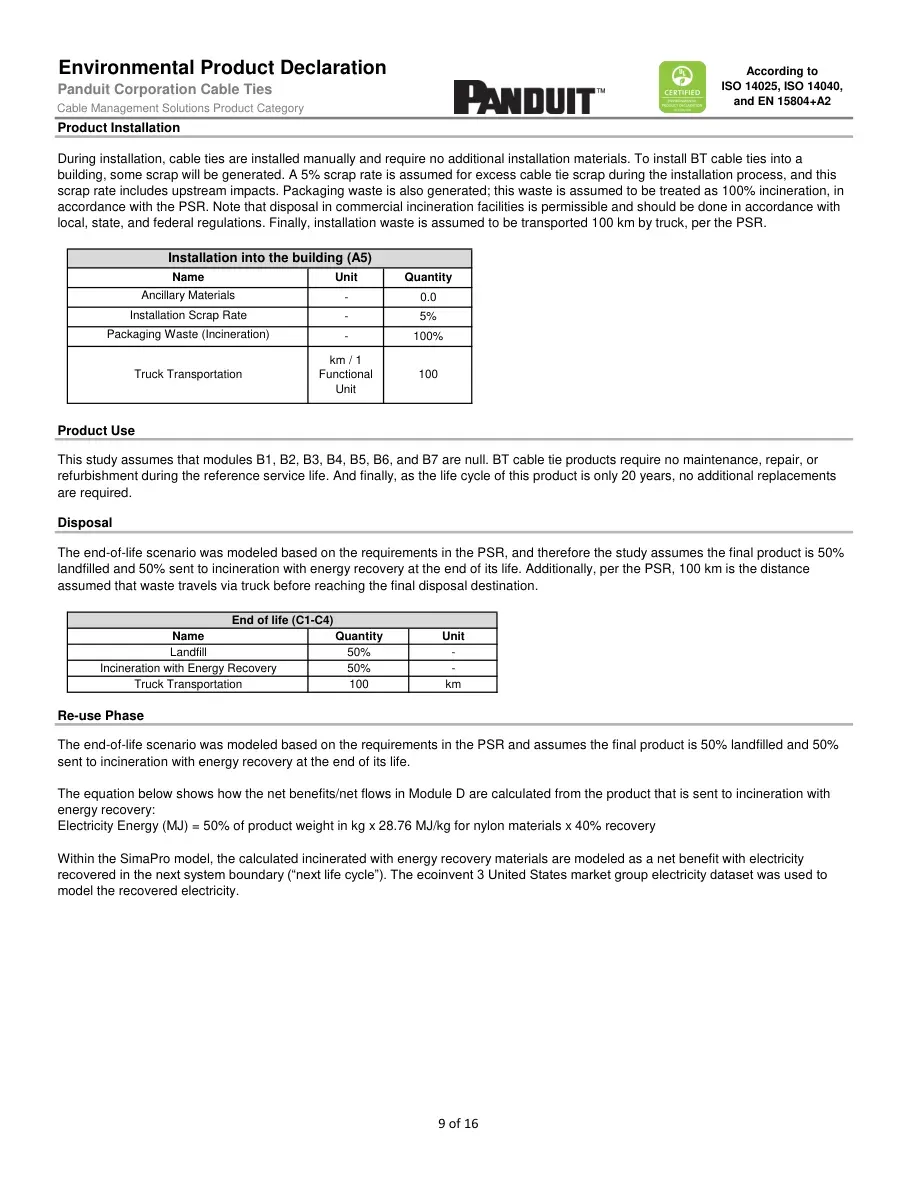
Panduit Corporation Cable TiesAccording toISO 14025, ISO 14040,and EN 15804+A2Cable Management Solutions Product CategoryEnvironmental Product DeclarationProduct UseThis study assumes that modules B1, B2, B3, B4, B5, B6, and B7 are null. BT cable tie products require no maintenance, repair, or refurbishment during the reference service life. And finally, as the life cycle of this product is only 20 years, no additional replacements are required.Re-use PhaseProduct InstallationkmLandfillInstallation Scrap RatePackaging Waste (Incineration)Truck TransportationThe end-of-life scenario was modeled based on the requirements in the PSR and assumes the final product is 50% landfilled and 50% sent to incineration with energy recovery at the end of its life. The equation below shows how the net benefits/net flows in Module D are calculated from the product that is sent to incineration with energy recovery:Electricity Energy (MJ) = 50% of product weight in kg x 28.76 MJ/kg for nylon materials x 40% recovery Within the SimaPro model, the calculated incinerated with energy recovery materials are modeled as a net benefit with electricity recovered in the next system boundary (“next life cycle”). The ecoinvent 3 United States market group electricity dataset was used to model the recovered electricity.The end-of-life scenario was modeled based on the requirements in the PSR, and therefore the study assumes the final product is 50% landfilled and 50% sent to incineration with energy recovery at the end of its life. Additionally, per the PSR, 100 km is the distance assumed that waste travels via truck before reaching the final disposal destination.NameIncineration with Energy RecoveryUnit--Truck TransportationDuring installation, cable ties are installed manually and require no additional installation materials. To install BT cable ties into a building, some scrap will be generated. A 5% scrap rate is assumed for excess cable tie scrap during the installation process, and this scrap rate includes upstream impacts. Packaging waste is also generated; this waste is assumed to be treated as 100% incineration, in accordance with the PSR. Note that disposal in commercial incineration facilities is permissible and should be done in accordance with local, state, and federal regulations. Finally, installation waste is assumed to be transported 100 km by truck, per the PSR. DisposalUnit---km / 1 Functional UnitQuantity0.05%100%100Installation into the building (A5)NameAncillary MaterialsQuantity50%50%100End of life (C1-C4) 9 of 16
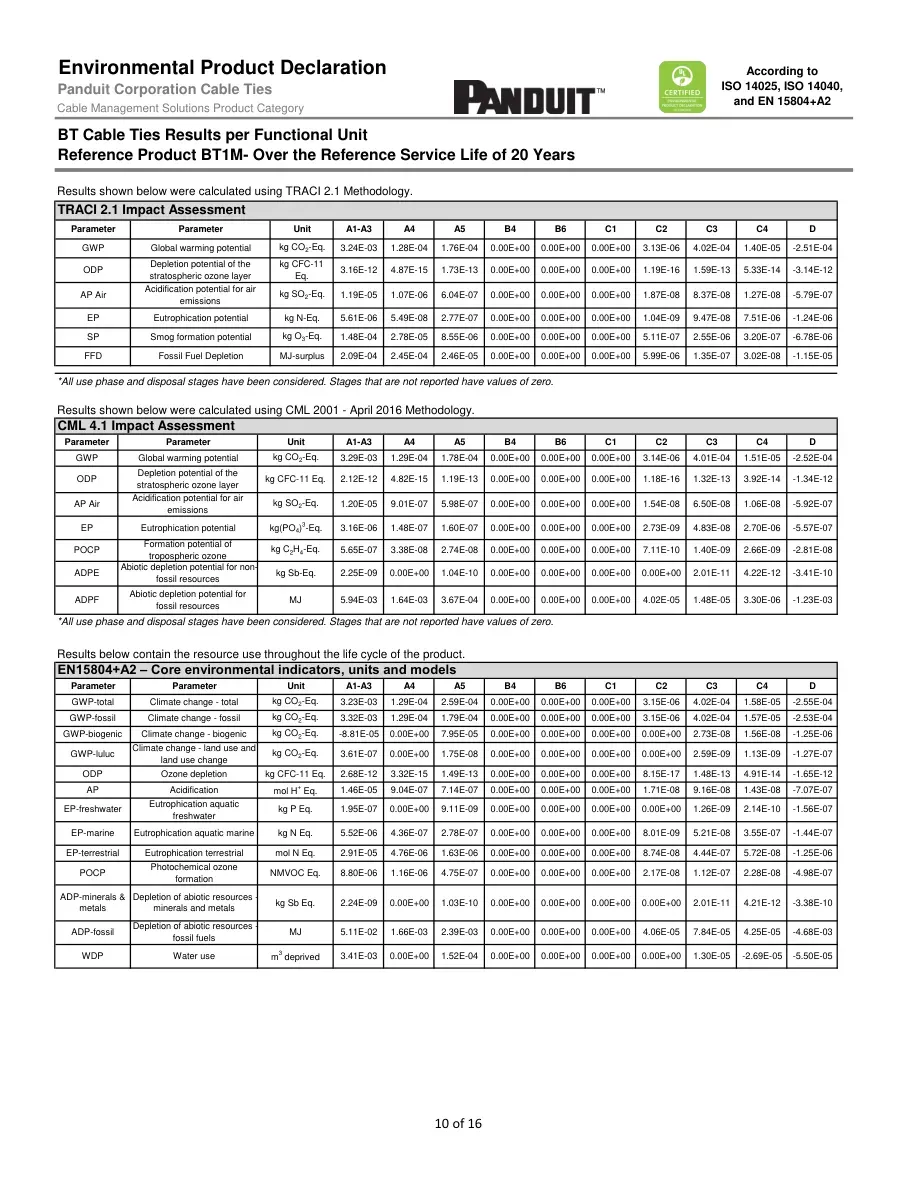
Panduit Corporation Cable TiesAccording toISO 14025, ISO 14040,and EN 15804+A2Cable Management Solutions Product CategoryEnvironmental Product DeclarationGlobal warming potential0.00E+001.57E-055.72E-08-1.25E-062.14E-103.67E-04A1-A34.21E-12-3.38E-10A5-6.78E-060.00E+001.04E-091.54E-083.16E-061.48E-071.60E-07-2.81E-08EP0.00E+005.49E-08GWP0.00E+000.00E+00Eutrophication potential-1.34E-120.00E+000.00E+000.00E+001.18E-161.06E-085.65E-07kg CO2-Eq.0.00E+000.00E+00ParameterParameterkg CO2-Eq.Abiotic depletion potential for fossil resources4.02E-041.58E-051.95E-070.00E+009.11E-090.00E+000.00E+00POCPPhotochemical ozone formation4.91E-14-1.65E-121.12E-072.01E-112.59E-091.13E-092.66E-093.92E-142.74E-087.11E-10kg C2H4-Eq.0.00E+00C21.48E-05C3C4kg Sb-Eq.Results below contain the resource use throughout the life cycle of the product.EN15804+A2 – Core environmental indicators, units and modelsUnitEutrophication potential0.00E+001.40E-093.38E-084.83E-08Depletion potential of the stratospheric ozone layerkg CFC-11 Eq.0.00E+00kg(PO4)3-Eq.5.98E-072.12E-122.01E-11D0.00E+003.30E-060.00E+000.00E+005.94E-031.64E-032.59E-040.00E+000.00E+000.00E+00C21.20E-05A1-A36.50E-08*All use phase and disposal stages have been considered. Stages that are not reported have values of zero.3.32E-032.28E-08-4.98E-071.03E-100.00E+000.00E+001.32E-13mol H+ Eq.1.43E-08-5.79E-07Global warming potential1.19E-161.59E-13kg CO2-Eq.GWPEP0.00E+008.55E-062.55E-066.04E-07MJ-surplus0.00E+000.00E+000.00E+002.45E-041.76E-040.00E+000.00E+00AP Air0.00E+000.00E+000.00E+000.00E+000.00E+002.73E-081.56E-084.02E-040.00E+00Climate change - fossil-8.81E-050.00E+009.47E-08B6C1kg CO2-Eq.SP0.00E+008.15E-171.48E-13ODPGWP-total3.23E-03kg CO2-Eq.0.00E+000.00E+009.01E-07MJ0.00E+000.00E+005.61E-060.00E+00B47.51E-06Fossil Fuel DepletionUnit1.29E-040.00E+00-5.92E-07CML 4.1 Impact Assessment2.09E-04C43.02E-083.20E-075.33E-143.13E-06C10.00E+000.00E+00Acidification potential for air emissionsC2kg SO2-Eq.1.78E-04Parameter2.73E-092.77E-07kg N-Eq.0.00E+000.00E+00AcidificationB4kg CO2-Eq.GWP-fossilGWP-biogenicADPFAP AirClimate change - biogenickg CFC-11 Eq.B6C10.00E+007.95E-05GWP-luluc1.46E-05Climate change - total1.48E-04*All use phase and disposal stages have been considered. Stages that are not reported have values of zero.Results shown below were calculated using CML 2001 - April 2016 Methodology.A44.02E-05ADPEA5ODPA4Depletion potential of the stratospheric ozone layerUnit1.28E-044.87E-15A5ODPTRACI 2.1 Impact Assessment-3.14E-12A1-A3B6C3-2.51E-04D1.73E-13POCP4.82E-151.19E-130.00E+000.00E+003.14E-06Acidification potential for air emissionskg SO2-Eq.0.00E+002.70E-065.99E-06Results shown below were calculated using TRACI 2.1 Methodology.BT Cable Ties Results per Functional Unit Reference Product BT1M- Over the Reference Service Life of 20 Yearskg CFC-11 Eq.-1.24E-060.00E+00B43.24E-034.02E-048.37E-08A4-2.52E-040.00E+00Formation potential of tropospheric ozone D5.11E-072.46E-05kg O3-Eq.EP-freshwaterEutrophication aquatic freshwaterClimate change - land use and land use change9.04E-071.29E-043.61E-070.00E+001.75E-080.00E+00AP1.27E-080.00E+001.19E-050.00E+001.07E-061.40E-05ParameterParameter0.00E+003.16E-122.78E-05Smog formation potential1.87E-08C3Parameter-1.15E-054.22E-122.68E-123.32E-151.49E-130.00E+000.00E+001.51E-05C4-7.07E-07-2.53E-04-3.41E-100.00E+003.29E-030.00E+001.04E-100.00E+00Abiotic depletion potential for non-fossil resources2.25E-094.01E-040.00E+001.29E-041.79E-040.00E+003.15E-06FFD1.35E-07-1.23E-03-5.57E-07Ozone depletion-1.56E-07-2.55E-047.14E-070.00E+000.00E+000.00E+003.15E-062.78E-070.00E+000.00E+000.00E+008.01E-095.21E-083.55E-07-1.44E-071.71E-089.16E-08-1.25E-06-1.27E-070.00E+000.00E+001.26E-090.00E+00kg P Eq.8.80E-061.16E-064.75E-070.00E+000.00E+000.00E+00NMVOC Eq.kg Sb Eq.kg N Eq.5.52E-064.36E-072.91E-054.76E-062.24E-090.00E+002.17E-083.41E-030.00E+00WDPWater usem3 deprivedEP-marineEutrophication aquatic marineEP-terrestrialEutrophication terrestrialmol N Eq.ADP-fossilDepletion of abiotic resources -fossil fuelsMJADP-minerals & metalsDepletion of abiotic resources -minerals and metals1.63E-060.00E+000.00E+000.00E+008.74E-084.44E-075.11E-021.66E-032.39E-030.00E+00-4.68E-031.52E-040.00E+000.00E+000.00E+000.00E+001.30E-05-2.69E-05-5.50E-054.25E-050.00E+000.00E+004.06E-057.84E-05 10 of 16
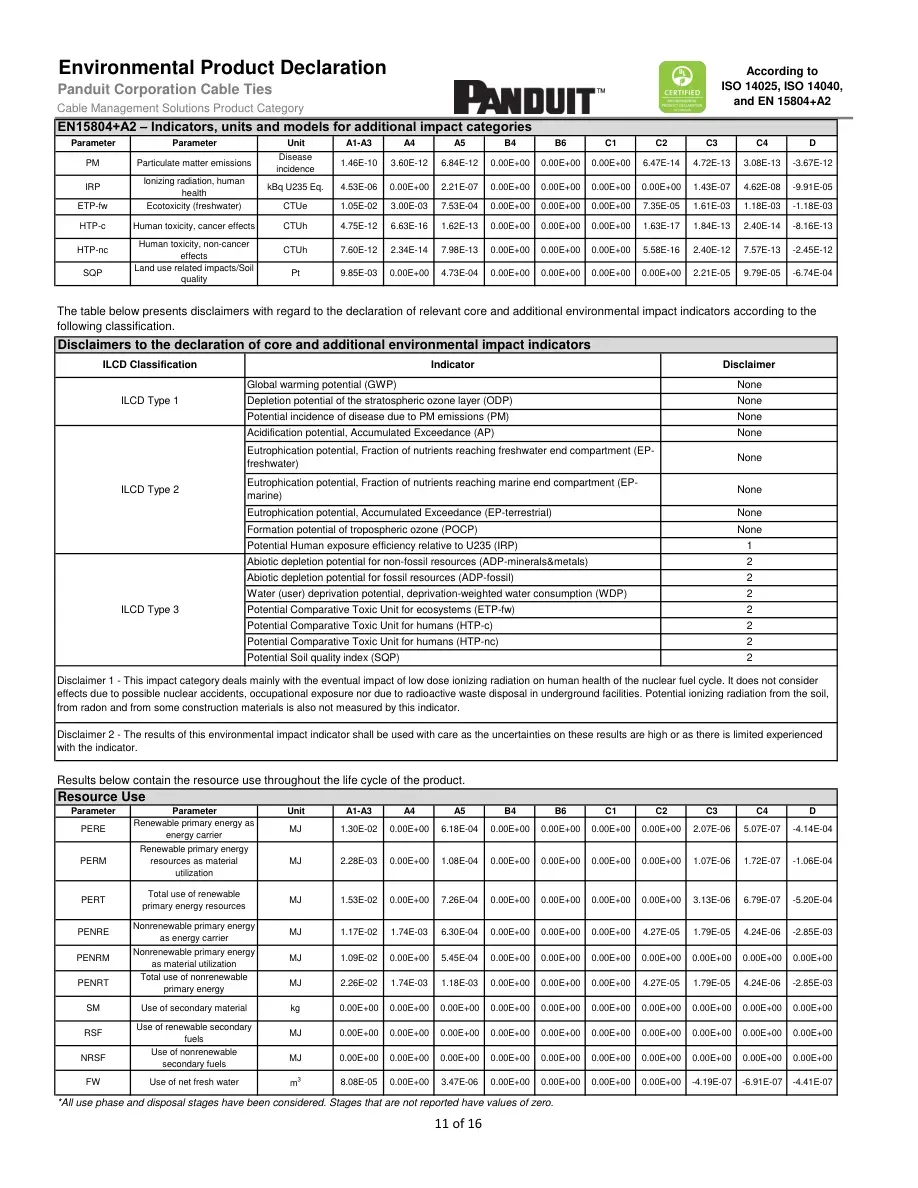
Panduit Corporation Cable TiesAccording toISO 14025, ISO 14040,and EN 15804+A2Cable Management Solutions Product CategoryEnvironmental Product Declaration0.00E+000.00E+000.00E+004.27E-051.79E-05NoneDepletion potential of the stratospheric ozone layer (ODP)NonePotential incidence of disease due to PM emissions (PM)NoneILCD Type 2Acidification potential, Accumulated Exceedance (AP)ILCD Type 3Abiotic depletion potential for non-fossil resources (ADP-minerals&metals)2Abiotic depletion potential for fossil resources (ADP-fossil)NoneNoneEutrophication potential, Fraction of nutrients reaching marine end compartment (EP-marine)1.43E-074.62E-087.60E-12Potential Soil quality index (SQP)2Disclaimer 1 - This impact category deals mainly with the eventual impact of low dose ionizing radiation on human health of the nuclear fuel cycle. It does not consider effects due to possible nuclear accidents, occupational exposure nor due to radioactive waste disposal in underground facilities. Potential ionizing radiation from the soil, from radon and from some construction materials is also not measured by this indicator.Disclaimer 2 - The results of this environmental impact indicator shall be used with care as the uncertainties on these results are high or as there is limited experienced with the indicator.4.24E-06-2.85E-032Water (user) deprivation potential, deprivation-weighted water consumption (WDP)2Potential Comparative Toxic Unit for ecosystems (ETP-fw)2Potential Comparative Toxic Unit for humans (HTP-c)20.00E+00Disclaimers to the declaration of core and additional environmental impact indicatorsILCD Classification0.00E+000.00E+000.00E+00Renewable primary energy resources as material utilizationMJ0.00E+00-1.06E-04Formation potential of tropospheric ozone (POCP)PENRTTotal use of nonrenewable primary energyMJ2.26E-021.74E-031.18E-030.00E+00FW-4.41E-070.00E+000.00E+000.00E+00-4.19E-07Use of net fresh waterPENREMJ0.00E+000.00E+000.00E+000.00E+000.00E+006.30E-044.27E-050.00E+000.00E+000.00E+000.00E+001.17E-021.74E-030.00E+000.00E+000.00E+001.09E-02NRSFRSF0.00E+00-6.91E-070.00E+000.00E+000.00E+000.00E+000.00E+00-2.85E-030.00E+00*All use phase and disposal stages have been considered. Stages that are not reported have values of zero.0.00E+000.00E+000.00E+000.00E+000.00E+000.00E+000.00E+000.00E+000.00E+000.00E+004.24E-06Use of renewable secondary fuelsMJNonrenewable primary energy as material utilizationPENRM1.79E-050.00E+001.53E-020.00E+007.26E-040.00E+000.00E+000.00E+00IndicatorDisclaimer0.00E+003.13E-066.79E-07-5.20E-04Renewable primary energy as energy carrier0.00E+00Eutrophication potential, Fraction of nutrients reaching freshwater end compartment (EP-freshwater)NoneResults below contain the resource use throughout the life cycle of the product.C4NonePotential Human exposure efficiency relative to U235 (IRP)1Eutrophication potential, Accumulated Exceedance (EP-terrestrial)NonePERMMJ-4.14E-04Resource UseB4The table below presents disclaimers with regard to the declaration of relevant core and additional environmental impact indicators according to the following classification.Potential Comparative Toxic Unit for humans (HTP-nc)2ILCD Type 1Global warming potential (GWP)PERTTotal use of renewable primary energy resourcesMJD5.07E-07PERE0.00E+00A4A55.45E-040.00E+006.18E-04B60.00E+000.00E+00C31.72E-071.30E-022.28E-030.00E+000.00E+00MJNonrenewable primary energy as energy carrierC2A1-A3ParameterC11.08E-041.07E-062.07E-06ParameterUnit0.00E+000.00E+000.00E+008.08E-050.00E+003.47E-060.00E+00Use of nonrenewable secondary fuelsm30.00E+00SMUse of secondary materialkg0.00E+000.00E+00MJ0.00E+000.00E+00HTP-ncHuman toxicity, non-cancer effectsCTUhSQPLand use related impacts/Soil qualityPt7.98E-130.00E+005.58E-162.40E-124.53E-060.00E+004.75E-126.63E-169.85E-030.00E+00PMParticulate matter emissionsDisease incidenceA5B4B6C12.34E-140.00E+000.00E+002.21E-07C2C3IRPIonizing radiation, human healthkBq U235 Eq.ETP-fwEcotoxicity (freshwater)CTUeHTP-cHuman toxicity, cancer effectsCTUh1.84E-131.46E-103.60E-126.84E-120.00E+000.00E+000.00E+006.47E-144.72E-133.08E-13-3.67E-12EN15804+A2 – Indicators, units and models for additional impact categoriesParameterParameterUnitA1-A3A4C4D7.57E-13-2.45E-124.73E-040.00E+000.00E+000.00E+000.00E+002.21E-059.79E-05-6.74E-04-9.91E-051.05E-023.00E-037.53E-040.00E+000.00E+000.00E+007.35E-051.61E-031.18E-03-1.18E-031.62E-130.00E+000.00E+000.00E+001.63E-172.40E-14-8.16E-130.00E+000.00E+000.00E+000.00E+00 11 of 16
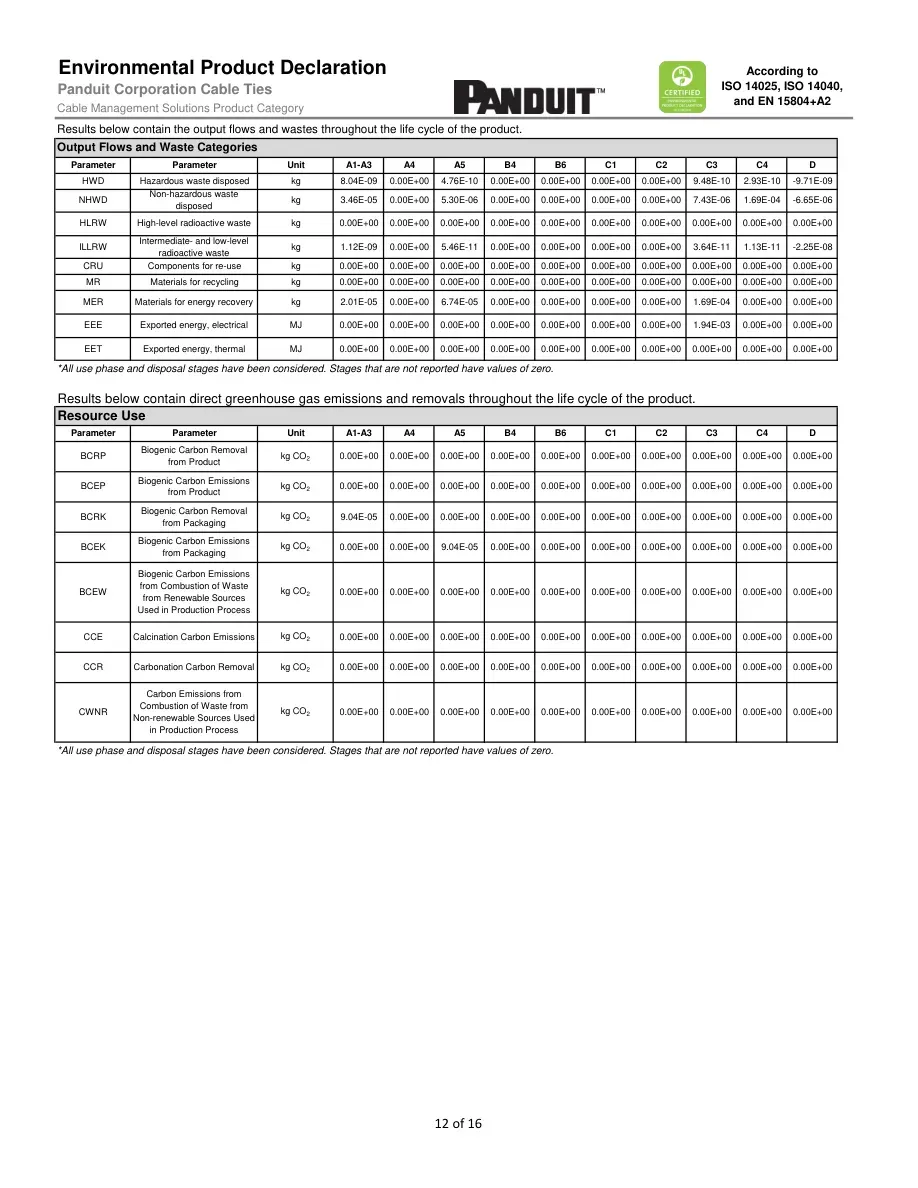
Panduit Corporation Cable TiesAccording toISO 14025, ISO 14040,and EN 15804+A2Cable Management Solutions Product CategoryEnvironmental Product DeclarationEEEExported energy, electricalMJ0.00E+000.00E+000.00E+000.00E+000.00E+000.00E+000.00E+001.94E-030.00E+000.00E+00B60.00E+000.00E+000.00E+000.00E+000.00E+00BCEPBiogenic Carbon Emissions from Product0.00E+000.00E+009.04E-050.00E+000.00E+000.00E+000.00E+000.00E+000.00E+001.13E-110.00E+000.00E+00A50.00E+000.00E+007.43E-06ParameterParameterC10.00E+000.00E+000.00E+000.00E+000.00E+000.00E+00B61.12E-095.46E-110.00E+000.00E+000.00E+000.00E+00C10.00E+00CRUComponents for re-use0.00E+000.00E+000.00E+000.00E+000.00E+00HLRWILLRW3.46E-050.00E+005.30E-060.00E+000.00E+00A42.01E-05A50.00E+00kg CO20.00E+000.00E+000.00E+00kg CO20.00E+000.00E+00Exported energy, thermal*All use phase and disposal stages have been considered. Stages that are not reported have values of zero.0.00E+00BCEW0.00E+00Materials for recyclingMRkg0.00E+000.00E+000.00E+00-2.25E-080.00E+000.00E+000.00E+00*All use phase and disposal stages have been considered. Stages that are not reported have values of zero.0.00E+000.00E+000.00E+00CCRCarbonation Carbon Removal0.00E+000.00E+000.00E+000.00E+00Calcination Carbon Emissions0.00E+00kg CO20.00E+00kg CO20.00E+000.00E+000.00E+000.00E+000.00E+000.00E+00CWNRCarbon Emissions from Combustion of Waste from Non-renewable Sources Used in Production Processkg CO20.00E+000.00E+000.00E+000.00E+000.00E+000.00E+000.00E+000.00E+00Results below contain direct greenhouse gas emissions and removals throughout the life cycle of the product.D0.00E+000.00E+000.00E+000.00E+000.00E+000.00E+000.00E+00BCEK0.00E+000.00E+000.00E+000.00E+000.00E+000.00E+00Parameter0.00E+000.00E+000.00E+000.00E+000.00E+00kg CO20.00E+00kg CO29.04E-050.00E+000.00E+00Biogenic Carbon Emissions from Combustion of Waste from Renewable Sources Used in Production ProcessC4BCRKEET0.00E+000.00E+000.00E+000.00E+000.00E+00C3Resource Use0.00E+000.00E+000.00E+003.64E-114.76E-100.00E+00kgNHWD0.00E+000.00E+00Non-hazardous waste disposed9.48E-102.93E-100.00E+00kgBCRPBiogenic Carbon Removal from ProductA1-A31.69E-048.04E-090.00E+00HWDC4C20.00E+00C3B4Unit0.00E+000.00E+000.00E+00Output Flows and Waste CategoriesResults below contain the output flows and wastes throughout the life cycle of the product.A1-A3A40.00E+000.00E+000.00E+000.00E+000.00E+000.00E+000.00E+00-9.71E-09DMaterials for energy recovery0.00E+000.00E+000.00E+00Unitkg CO2Biogenic Carbon Emissions from Packaging0.00E+00kgkg0.00E+00MJHazardous waste disposedHigh-level radioactive waste0.00E+001.69E-040.00E+000.00E+000.00E+00-6.65E-060.00E+00B46.74E-050.00E+000.00E+000.00E+00Biogenic Carbon Removal from PackagingC20.00E+000.00E+000.00E+000.00E+000.00E+000.00E+000.00E+00kgIntermediate- and low-level radioactive wastekg0.00E+000.00E+00ParameterMERCCE 12 of 16
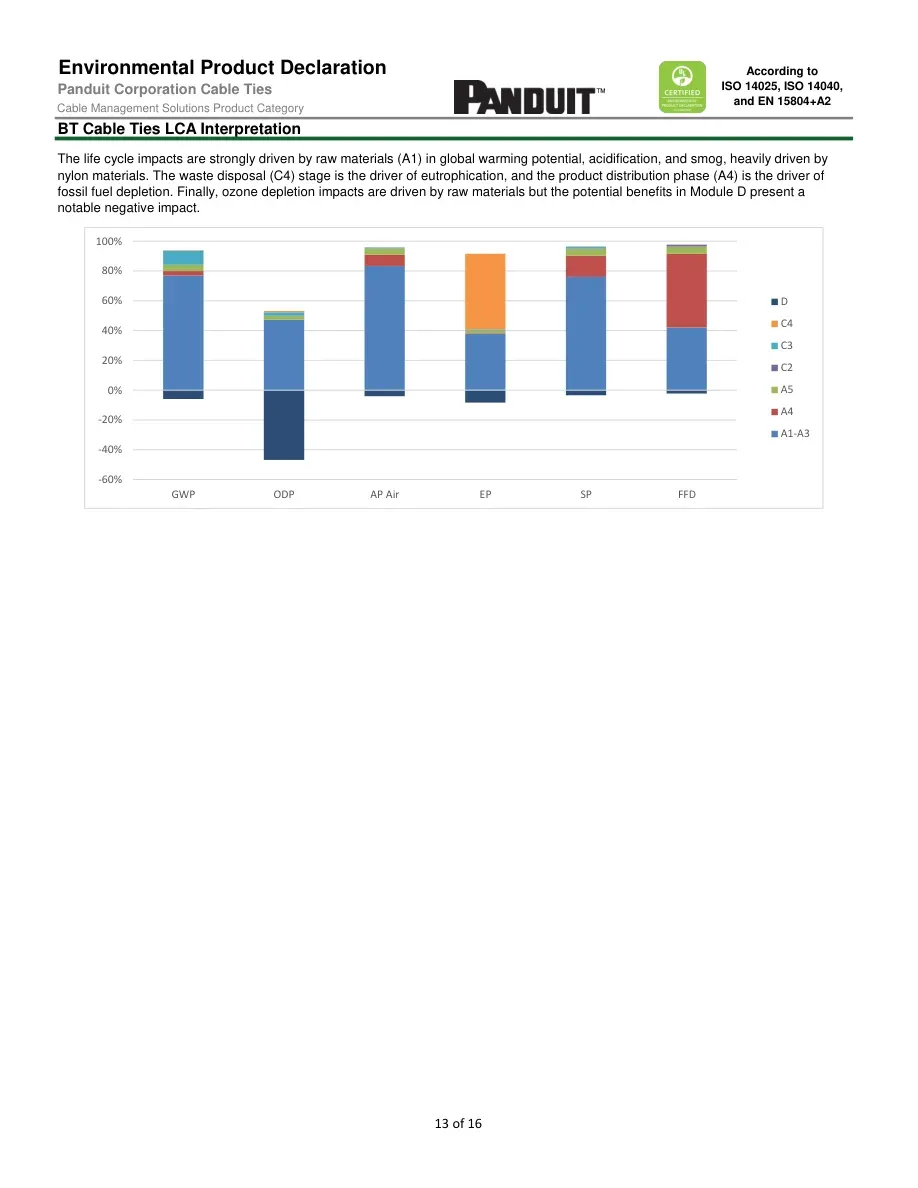
Panduit Corporation Cable TiesAccording toISO 14025, ISO 14040,and EN 15804+A2Cable Management Solutions Product CategoryEnvironmental Product DeclarationBT Cable Ties LCA InterpretationThe life cycle impacts are strongly driven by raw materials (A1) in global warming potential, acidification, and smog, heavily driven by nylon materials. The waste disposal (C4) stage is the driver of eutrophication, and the product distribution phase (A4) is the driver of fossil fuel depletion. Finally, ozone depletion impacts are driven by raw materials but the potential benefits in Module D present a notable negative impact.-60%-40%-20%0%20%40%60%80%100%GWPODPAP AirEPSPFFDDC4C3C2A5A4A1-A3 13 of 16
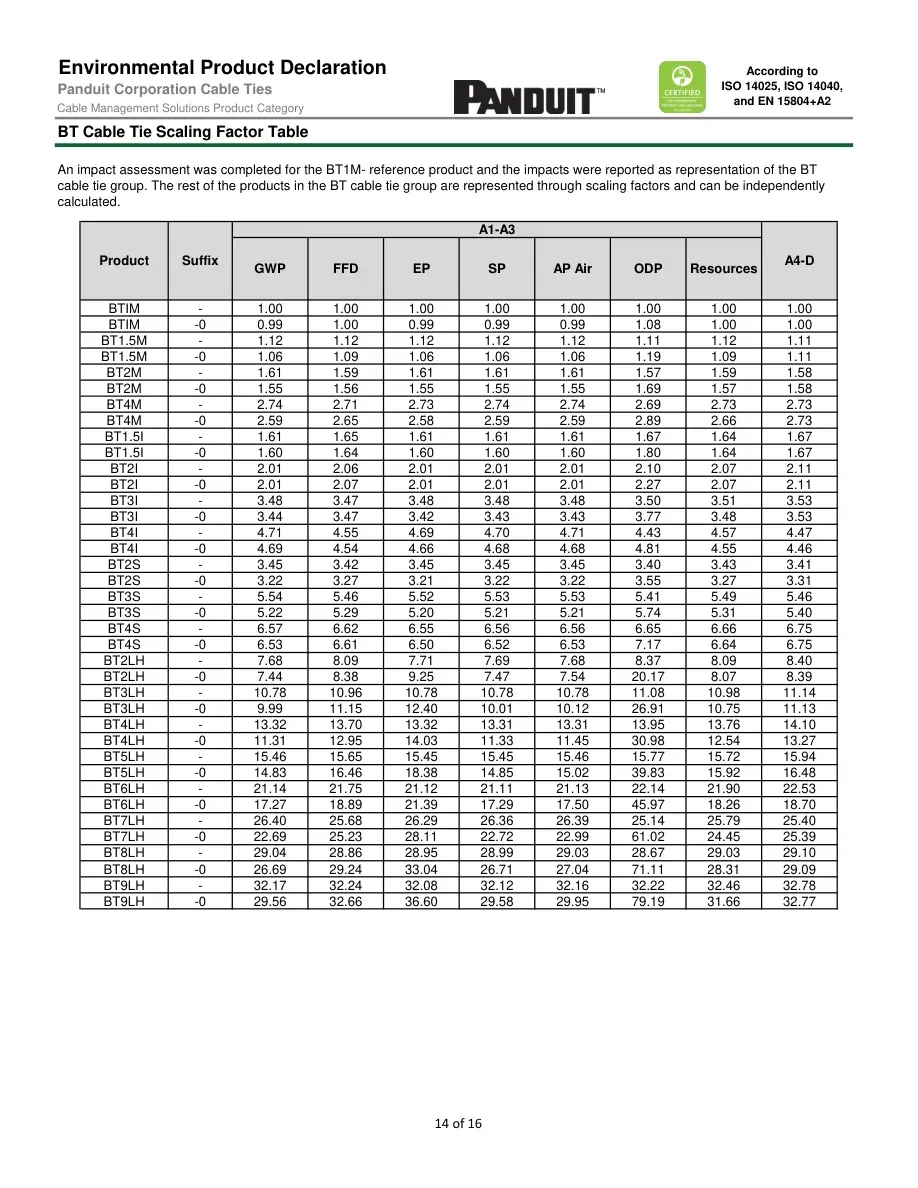
Panduit Corporation Cable TiesAccording toISO 14025, ISO 14040,and EN 15804+A2Cable Management Solutions Product CategoryEnvironmental Product DeclarationProductSuffixA1-A3 A4-DBT Cable Tie Scaling Factor TableAn impact assessment was completed for the BT1M- reference product and the impacts were reported as representation of the BT cable tie group. The rest of the products in the BT cable tie group are represented through scaling factors and can be independently calculated.BTIMGWPFFDEPSPAP AirODPResources-1.001.001.001.001.001.001.001.00BTIM-00.991.000.990.990.991.081.001.00BT1.5M-1.121.121.121.121.121.111.121.11BT1.5M-01.061.091.061.061.061.191.091.11BT2M-1.611.591.611.611.611.571.591.58BT2M-01.551.561.551.551.551.691.571.58BT4M-2.742.712.732.742.742.692.732.73BT4M-02.592.652.582.592.592.892.662.73BT1.5I-1.611.651.611.611.611.671.641.67BT1.5I-01.601.641.601.601.601.801.641.67BT2I-2.012.062.012.012.012.102.072.11BT2I-02.012.072.012.012.012.272.072.11BT3I-3.483.473.483.483.483.503.513.53BT3I-03.443.473.423.433.433.773.483.53BT4I-4.714.554.694.704.714.434.574.47BT4I-04.694.544.664.684.684.814.554.46BT2S-3.453.423.453.453.453.403.433.41BT2S-03.223.273.213.223.223.553.273.31BT3S-5.545.465.525.535.535.415.495.46BT3S-05.225.295.205.215.215.745.315.40BT4S-6.576.626.556.566.566.656.666.75BT4S-06.536.616.506.526.537.176.646.75BT2LH-7.688.097.717.697.688.378.098.40BT2LH-07.448.389.257.477.5420.178.078.39BT3LH-10.7810.9610.7810.7810.7811.0810.9811.14BT3LH-09.9911.1512.4010.0110.1226.9110.7511.13BT4LH-13.3213.7013.3213.3113.3113.9513.7614.10BT4LH-011.3112.9514.0311.3311.4530.9812.5413.27BT5LH-15.4615.6515.4515.4515.4615.7715.7215.94BT5LH-014.8316.4618.3814.8515.0239.8315.9216.48BT6LH-21.1421.7521.1221.1121.1322.1421.9022.53BT6LH-017.2718.8921.3917.2917.5045.9718.2618.70BT7LH-26.4025.6826.2926.3626.3925.1425.7925.40BT7LH-022.6925.2328.1122.7222.9961.0224.4525.39BT9LH-029.5632.6636.6029.5829.9579.1931.6632.77BT8LH-026.6929.2433.0426.7127.0471.1128.3129.09BT9LH-32.1732.2432.0832.1232.1632.2232.4632.78BT8LH-29.0428.8628.9528.9929.0328.6729.0329.10 14 of 16
Panduit Corporation Cable TiesAccording toISO 14025, ISO 14040,and EN 15804+A2Cable Management Solutions Product CategoryEnvironmental Product DeclarationGlobal warming potential is calculated using the TRACI 2.1 and CML 4.1 impact assessment methodologies. Delayed emissions are not considered.Delayed EmissionsThere are no negative environmental effects resulting from mechanical destruction.Environmental Activities and CertificationsFurther InformationPanduit is ISO 14001 : 2015 certified company. At Panduit, we wholeheartedly embrace environmental sustainability. We actively minimize our environmental impact by implementing practices that effectively reduce waste, conserve energy, and responsibly source materials. Our commitment to sustainability permeates every aspect of our operations, and we continually seek innovative ways to diminish our ecological footprint. We firmly believe that safeguarding the environment is not only a responsibility, but also a vital opportunity to deeply engage our employees and deliver exceptional customer value.Product melts when exposed to fire, producing substances such as CO, CO2 and NO2.There are no negative environmental effects resulting from exposure to water.WaterThere is no harmful emissive potential. No damage to health or impairment is expected under normal use, if recommended manufacturer's installation practices are followed, corresponding to the intended use of the product. Extraordinary EffectsEnvironmental and Health During InstallationAt Panduit, we believe our people are our most valuable resource. Accordingly, ensuring the health and safety of our employees, as well as contractors and any other individuals involved with our business, is of utmost importance to us. Panduit devotes the necessary and appropriate attention to ensure that our operations are safe. In doing so, we relentlessly pursue our ultimate goal of zero occupational illnesses and injuries. Panduit implements this Health and Safety Policy through a global Occupational Health and Safety Management System which meets or exceeds all local health and safety legal requirements where we operate.Environmental and Health During ManufacturingMark DehmlowManager, Global Sustainabilitymark.dehmlow@panduit.comTel. +17792544743; ext=84743Panduit Tinley Park HeadquartersMechanical DestructionFire15 of 16
Panduit Corporation Cable TiesAccording toISO 14025, ISO 14040,and EN 15804+A2Cable Management Solutions Product CategoryEnvironmental Product Declaration---------PEP ecopassport Program: Product Specific Rules for Cable Management Solutions, v2.0, 2023 (PSR Part B)ISO 14044:2006-10, Environmental management — Life cycle assessment — Requirements and guidelines.ISO 14040:2009-11, Environmental management — Life cycle assessment — Principles and framework.PRé Sustainability. SimaPro Life Cycle Assessment version 9.6.0.1 (software).EN 15804+A2:2019: Sustainability of construction works — Environmental Product Declarations — Core rules for the product category of construction productISO 14025:2011-10, Environmental labels and declarations — Type III environmental declarations — Principles and procedures.SimaPro v9.6.0.1EN 15804+A2ASTM 2020PCR Part ACharacterization MethodStudy CommissionerLCA PractitionerPanduit Corporation16530 W. 163rd StreetLockport, IL 60441USAContact InformationIPCC. 2018. Climate Change 2013. The Physical Science Basis. Cambridge University Press. (http://www.ipcc.ch/report/ar5/wg1/).PSR Part BSustainable Solutions Corporation155 Railroad Plaza, Suite 203Royersford, PA 19468 USA(+1) 610 569-1047info@sustainablesolutionscorporation.com www.sustainablesolutionscorporation.comReferencesASTM International General Program Instructions v8.0, April 29, 2020Product Category Rule (PCR) PEP ecopassport Program: Product Category Rules for Electrical, Electronic and HVAC-R Products, v4.0, 2021 (PCR Part A)ISO 14025ISO 14040ISO 1404416 of 16This declaration is an environmental product declaration (EPD) in accordance with ISO 14025 and has been developed according to PEP ecopassport program PCRs and PSRs. Comparability: EPDs are not comparative assertions and are either not comparable or have limited comparability when they cover different life cycle stages, are based on different product category rules or are missing relevant enviromental impacts. Although the EPD is using PEP ecopassport PCR and PSR, its content cannot be compared with content based on PEP ecopassport program.
