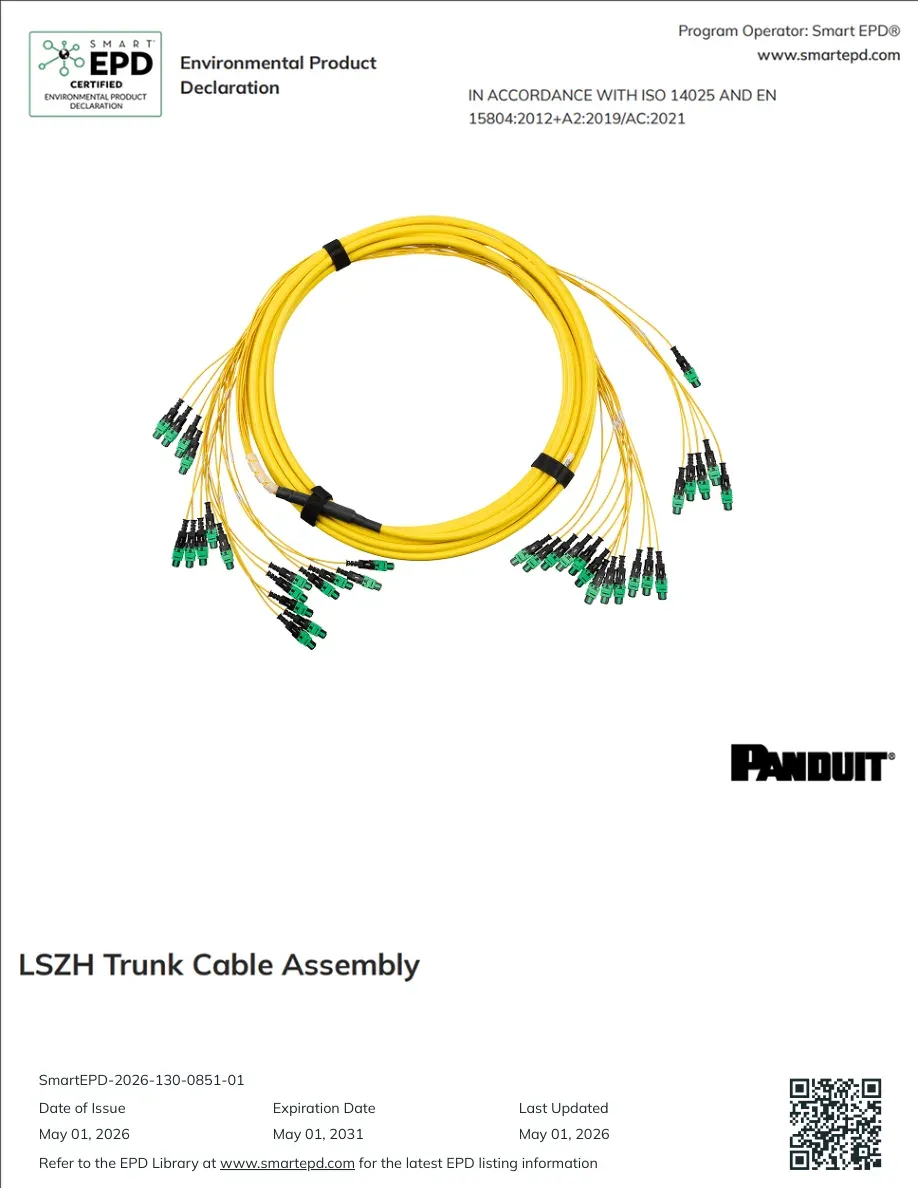
SmartEPD-2026-130-0851-01Date of IssueMay 01, 2026Expiration DateMay 01, 2031Last UpdatedMay 01, 2026Refer to the EPD Library at www.smartepd.com for the latest EPD listing information
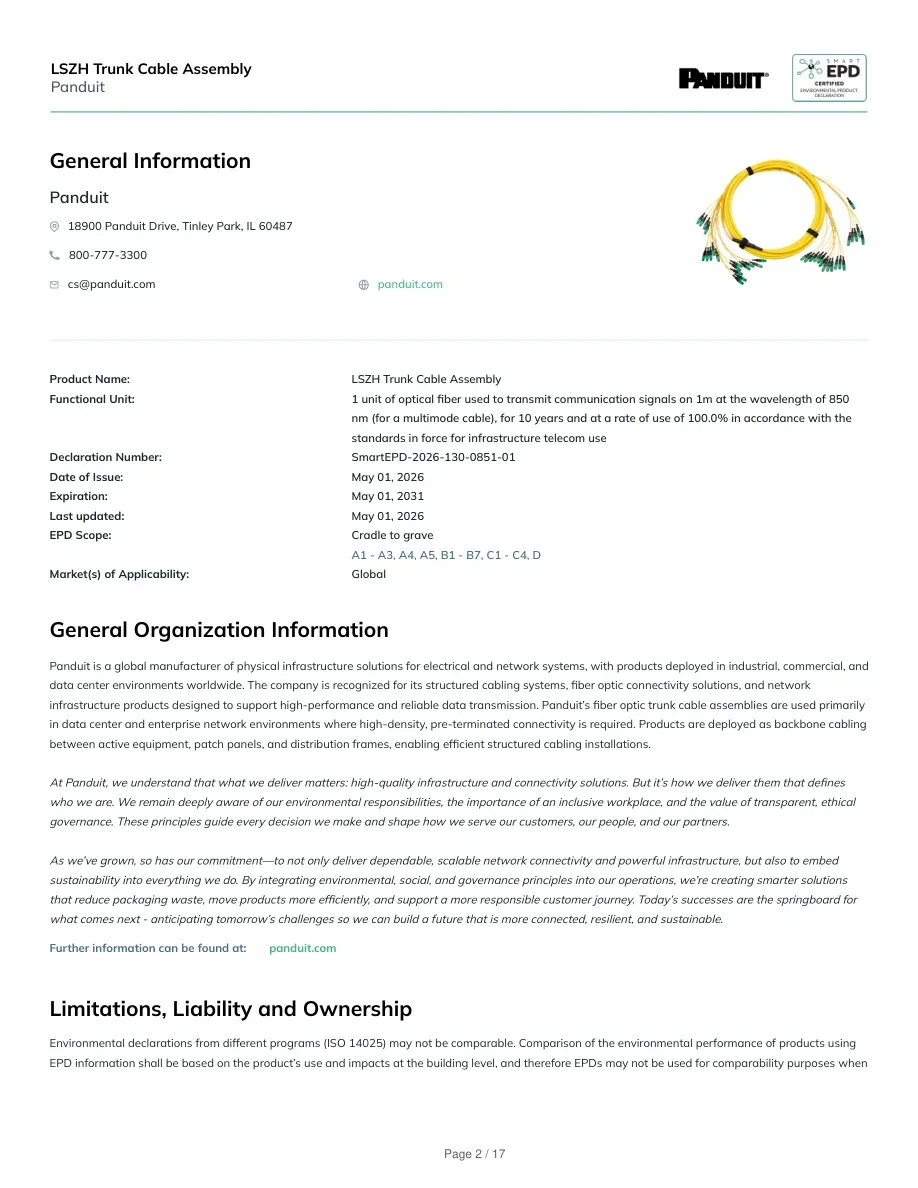
General InformationPanduit18900 Panduit Drive, Tinley Park, IL 60487800-777-3300cs@panduit.companduit.comProduct Name:LSZH Trunk Cable AssemblyFunctional Unit:1 unit of optical fiber used to transmit communication signals on 1m at the wavelength of 850nm (for a multimode cable), for 10 years and at a rate of use of 100.0% in accordance with thestandards in force for infrastructure telecom useDeclaration Number:SmartEPD-2026-130-0851-01Date of Issue:May 01, 2026Expiration:May 01, 2031Last updated:May 01, 2026EPD Scope:Cradle to graveA1 - A3, A4, A5, B1 - B7, C1 - C4, DMarket(s) of Applicability:GlobalGeneral Organization InformationPanduit is a global manufacturer of physical infrastructure solutions for electrical and network systems, with products deployed in industrial, commercial, anddata center environments worldwide. The company is recognized for its structured cabling systems, fiber optic connectivity solutions, and networkinfrastructure products designed to support high-performance and reliable data transmission. Panduit’s fiber optic trunk cable assemblies are used primarilyin data center and enterprise network environments where high-density, pre-terminated connectivity is required. Products are deployed as backbone cablingbetween active equipment, patch panels, and distribution frames, enabling efficient structured cabling installations.At Panduit, we understand that what we deliver matters: high-quality infrastructure and connectivity solutions. But it’s how we deliver them that defineswho we are. We remain deeply aware of our environmental responsibilities, the importance of an inclusive workplace, and the value of transparent, ethicalgovernance. These principles guide every decision we make and shape how we serve our customers, our people, and our partners.As we’ve grown, so has our commitment—to not only deliver dependable, scalable network connectivity and powerful infrastructure, but also to embedsustainability into everything we do. By integrating environmental, social, and governance principles into our operations, we’re creating smarter solutionsthat reduce packaging waste, move products more efficiently, and support a more responsible customer journey. Today’s successes are the springboard forwhat comes next - anticipating tomorrow’s challenges so we can build a future that is more connected, resilient, and sustainable.Further information can be found at:panduit.comLimitations, Liability and OwnershipEnvironmental declarations from different programs (ISO 14025) may not be comparable. Comparison of the environmental performance of products usingEPD information shall be based on the product’s use and impacts at the building level, and therefore EPDs may not be used for comparability purposes whenLSZH Trunk Cable AssemblyPanduitPage 2 / 17
not considering the whole building life cycle. EPD comparability is only possible when all stages of a life cycle have been considered. However, variations anddeviations are possible. Example of variations: Different LCA software and background LCI datasets may lead to differences results for upstream ordownstream of the life cycle stages declared. The EPD owner has sole ownership, liability, and responsibility for the EPD.Reference StandardsStandard(s):ISO 14025 and EN 15804:2012+A2:2019/AC:2021Core PCR:PEP PCR Electrical, Electronic and HVAC-R Products v.4Date of issue: September 06, 2021Sub-category PCR:PEP ecopassport® PROGRAM PSR Specific Rules for Wires, Cables and Accessories (PSR-0001-ed4-EN-2022 11 16)Date of issue: November 16, 2022Valid until: November 01, 2027Sub-category PCR review panel:Contact Smart EPD for more information.General Program Instructions:Smart EPD General Program Instructions v.2.0, March 2025Verification InformationLCA Author/Creator:Seth RogersPARQseth@parqhq.comEPD Program Operator:Smart EPDinfo@smartepd.comwww.smartepd.com585 Grove St., Ste. 145, Herndon, VA 20170, USAVerification:Independent critical review of the LCA and data, according to ISO 14044 andISO 14071:ExternalRifat KarimIndependent Consultantrifat.chimique@gmail.comIndependent external verification of EPD, according to ISO 14025 andreference PCR(s):ExternalRifat KarimIndependent Consultantrifat.chimique@gmail.comProduct InformationFunctional Unit:1 unit of optical fiber used to transmit communication signals on 1m at the wavelength of 850nm (for a multimode cable), for 10 years and at a rate of use of 100.0% in accordance with thestandards in force for infrastructure telecom useMass:0.0014 kgReference Service Life:10 YearsProduct Specificity:Product AverageProduct SpecificLSZH Trunk Cable AssemblyPanduitPage 3 / 17
Product DescriptionLow smoke zero halogen LC trunk cable assemblies shall allow for rapid deployment of high-density permanent links in a single assembly for data centerapplications requiring quick infrastructure deployment, such as main, horizontal, and zone distribution areas. These trunk cable assemblies shall optimizecable routing requirements to ensure efficient use of pathway space and significantly reduce installation time and cost. All LC trunk cable assemblies arefactory terminated and tested to deliver verified optical performance and reliability for improved network integrity at speeds of 10/25/40/50/100G andbeyond.Further information can be found at:https://www.panduit.com/content/dam/panduit/en/products/media/6/46/546/8546/111438546.pdfProduct SpecificationsProduct Classification Codes:EC3 - NetworkInfrastructure -> DataCablingMasterformat - 27 15 23Table 1. Material CompositionMaterial/Component CategoryOrigin% MassCableUS100.0Packaging MaterialOriginkg MassCardboardUS8.5E-5HdpepulleyeUS3.21E-6Plastic ldpeRoW2.54E-5Biogenic Carbon Contentkg C per unitBiogenic carbon content in product0NoneBiogenic carbon content in accompanyingpackaging0.000144Hazardous MaterialsNo regulated hazardous or dangerous substances are included in this product.EPD Data SpecificityPrimary Data Year:Jan 1, 2025 - Dec 31, 2025Manufacturing Specificity:Industry AverageManufacturer AverageLSZH Trunk Cable AssemblyPanduitPage 4 / 17
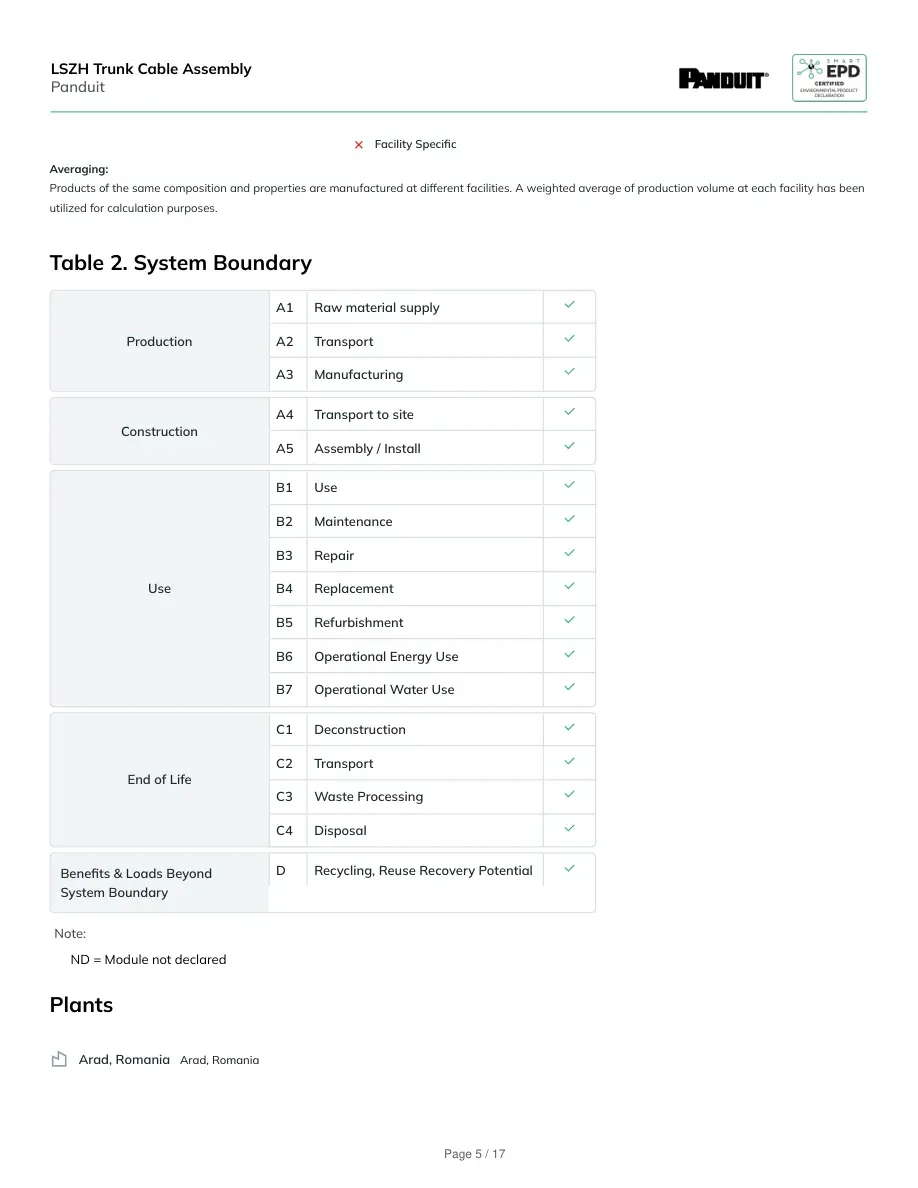
Facility SpecificAveraging:Products of the same composition and properties are manufactured at different facilities. A weighted average of production volume at each facility has beenutilized for calculation purposes.Table 2. System BoundaryProductionA1Raw material supplyA2TransportA3ManufacturingConstructionA4Transport to siteA5Assembly / InstallUseB1UseB2MaintenanceB3RepairB4ReplacementB5RefurbishmentB6Operational Energy UseB7Operational Water UseEnd of LifeC1DeconstructionC2TransportC3Waste ProcessingC4DisposalBenefits & Loads BeyondSystem BoundaryDRecycling, Reuse Recovery PotentialNote:ND = Module not declaredPlantsArad, RomaniaArad, RomaniaLSZH Trunk Cable AssemblyPanduitPage 5 / 17
Grecia, Costa RicaAlajuela Province, Grecia, Costa RicaProduct Flow DiagramSoftware And DatabaseLCA Software:SimaPro v. 10.2LCI Foreground Database(s):Ecoinvent v. 3.11Cut-off by ClassificationLCI Background Database(s):Ecoinvent v. 3.11Cut-off by ClassificationA foreground LCI database is the database used to model the primary, site-specific data collected for this EPD. A background LCI database is the databaseused to model generic or non-specific data.Data QualityPrecision & CompletenessPrecision: Inventory data were directly measured, calculated, or conservatively estimated from primary sources using consistent units and QA checks.Background processes from ecoinvent v3 were adopted with their documented uncertainty/precision metadata where available, preserving atransparent record of data quality.Completeness: The product system's mass balance and inventory completeness were thoroughly checked. Some exclusions were made in line with thePCR requirements, such as personnel impacts, R&D activities, business travel, and point-of-sale infrastructure. However, no data were intentionallyomitted.Consistency and ReproducibilityConsistency: Primary data for all modules were consistently gathered aiming at the highest level of detail possible. Background processes weremodeled mainly with the ecoinvent database. The same allocation rules, cut-off criteria, and impact assessment methods were applied throughout,ensuring methodological coherence and consistent data quality across the entire LCA model.Reproducibility: This study ensures reproducibility by providing comprehensive disclosure of input–output data, dataset choices, and modelingapproaches. A knowledgeable third party should be able to approximate the results using the same data and modeling methods.LSZH Trunk Cable AssemblyPanduitPage 6 / 17
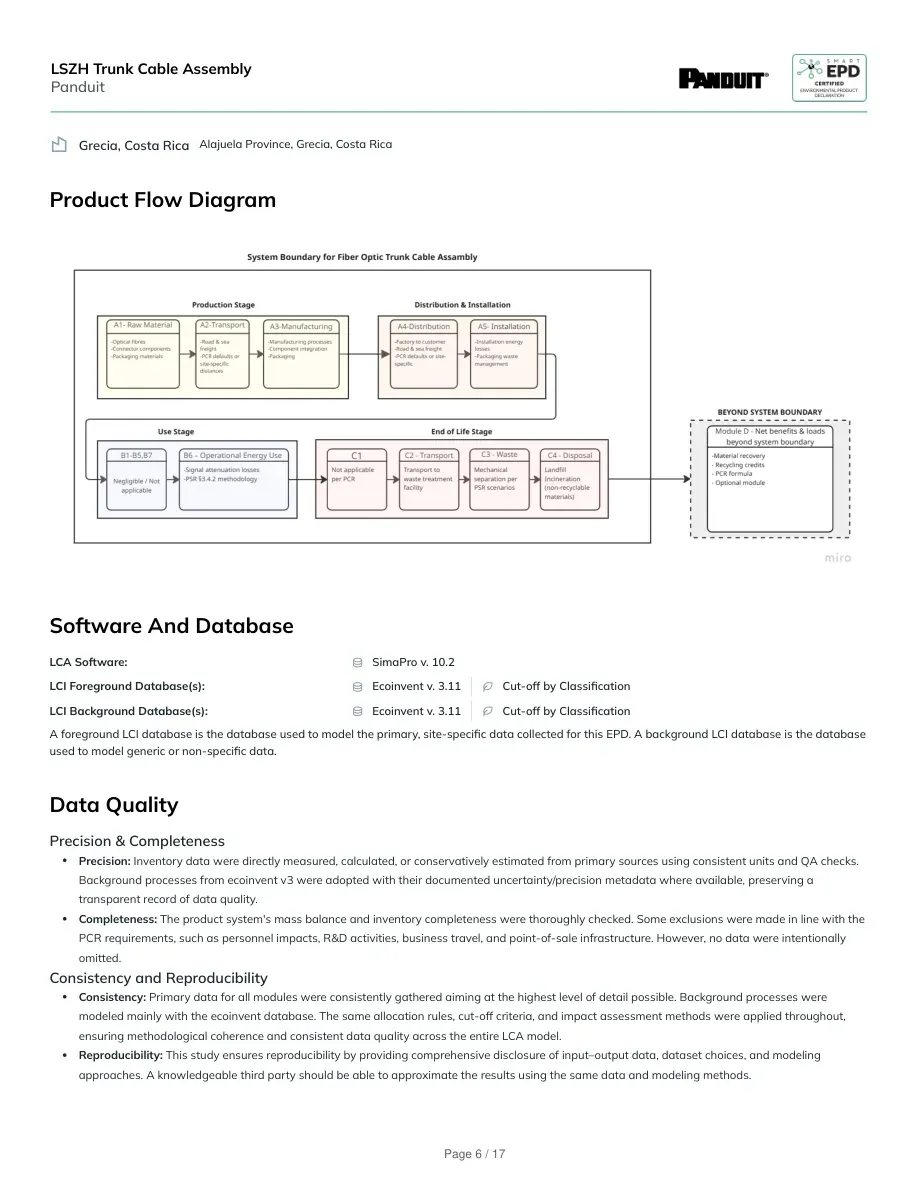
RepresentativenessTemporal: Primary data were collected for a 12-month period representing the 2025 calendar year to ensure the representativeness of post-consumercontent. Secondary data from the ecoinvent v3 database are typically representative of recent years.Geographical: Primary data represent Panduit's production facility. Where applicable, differences in electric grid mix were considered usingappropriate secondary data. The use of country-specific data ensures high geographical representativeness, and proxy data were only used whencountry-specific data were unavailable.Technological: Both primary and secondary data were tailored to the specific technologies studied, ensuring high technological representativeness.Life Cycle Module DescriptionModules A1–A3: The LCA model covers the production of raw materials and components for Panduit's fiber optic trunk cable assemblies (A1), which arethen transported to the assembly facility (A2). The fiber cable is sourced from external suppliers, while connector components are manufactured by Panduitand assembled at each end of the cable. At the manufacturing stage (A3), cables are cut to length, furcated, and stripped before connectors are assembled,polished, tested, labelled, and packaged. Primary data for facility resource consumption — including electricity use and fuel consumption — were collectedover a 12-month period and allocated by mass across all products manufactured.Modules A4–A5: Once manufacturing is completed, finished assemblies are transported to distribution centres and from there to the installation site (A4),modelled using the default transport scenarios of the PCR. For installation (A5), a default product loss rate of 5% is applied to the reference flow andpackaging waste treatment is included in accordance with the modularity principle of the PCR. Installation processes themselves are not modelled: the rangeof possible configurations — in terms of routing, fixings, conduit, and site conditions — is too varied to support a representative default scenario.Modules B1–B7: Modules B1–B5 and B7 are not applicable and set to zero per PSR Section 3.2; only B6 is relevant, capturing signal attenuation losses overthe reference service life calculated per PSR 3.4.4.2d.Modules C1–C4 and D: At end of life (C1–C4), assemblies are assumed to be removed from service and directed to appropriate waste managementprocesses. Module C1 (removal and dismantling) is excluded from the system boundary, as the variability of cable extraction conditions across installationsprecludes a representative default scenario. C2 covers transport to waste processing or disposal facilities. C3 encompasses mechanical separation of cablecomponents, with material-specific end-of-life routes applied per the treatment scenarios prescribed in the PSR. Remaining fractions not subject to recoveryare assigned to C4 landfill disposal. Module D, covering net benefits and loads beyond the system boundary, is optional and reported separately fromModules A–C. Where calculated, results are quantified using the end-of-life formula specified in the PCR and expressed per functional unit.LCA DiscussionAllocation ProcedureAllocation of co-products was avoided, to the extent possible, based on the guidance given in ISO 14044:2006, 4.3, and in EN 15804+A2:2019. Energy useat the facility level was allocated by the amount of product produced. The manufacturing process does not consume water or generate wastewater or airemissions, other than those from fuel combustion. Solid waste was estimated using packaging masses and material losses and allocated following thepolluter pays principle.Cut-off ProcedureThe system boundary was defined based on relevance to the goal of the study. For the raw material (A1) and process related inputs (A3), all availableenergy and material flow data have been included in the model.LSZH Trunk Cable AssemblyPanduitPage 7 / 17
Renewable ElectricityEnergy Attribute Certificates (EACs) such asRenewable Energy Certificates (RECs) or PowerPurchase Agreements (PPAs) are included in thebaseline reported results:NoScenariosTransport to the building/construction site (A4)A4 ModuleFuel Type:DieselVehicle Type:Truck and TrailerTransport Distance:3696 kmCapacity Utilization:33 %Packaging Mass:0.0001131 kgWeight of products transported:0.001523 kgCapacity utilization volume factor:1Assumptions for scenario development:Transport distance includes finished product to distribution center and distribution center to pointof sale.Installation in to the building/construction site (A5)A5 ModuleInstallation Scrap Rate Assumed:5 %Product Lost per Declared/Functional Unit:0.00007047 kgMass of Packaging Waste Specified by Type:0.0001131 kgBiogenic Carbon Contained in Packaging (kg C):0.00003924 kgAssumptions for scenario development:Use (B1)B1 ModuleDeclared Product Properties:Not Applicable. Module equal to 0, Section 3.2 of the PSRMaintenance (B2)B2 ModuleFurther assumptions for scenario development:Not Applicable. Module equal to 0, Section 3.2 of the PSRLSZH Trunk Cable AssemblyPanduitPage 8 / 17
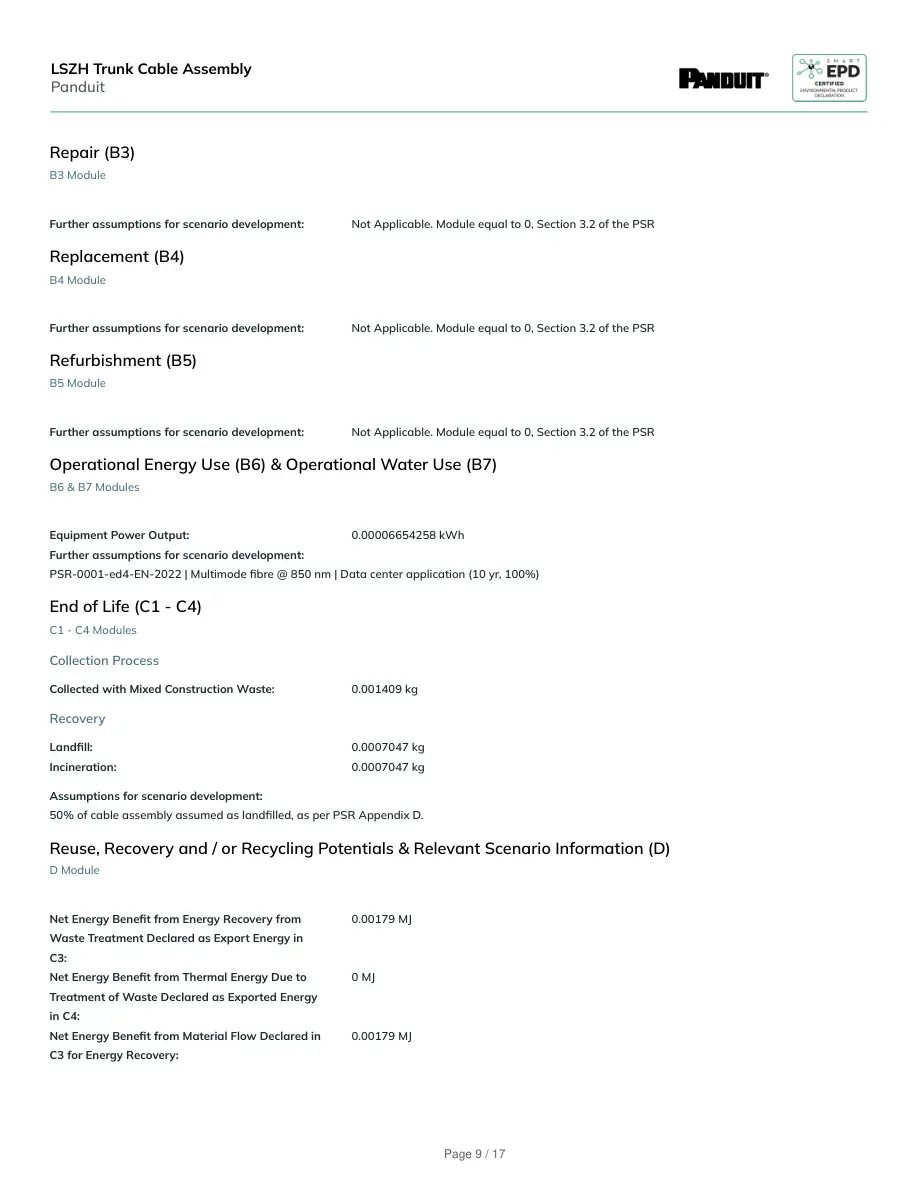
Repair (B3)B3 ModuleFurther assumptions for scenario development:Not Applicable. Module equal to 0, Section 3.2 of the PSRReplacement (B4)B4 ModuleFurther assumptions for scenario development:Not Applicable. Module equal to 0, Section 3.2 of the PSRRefurbishment (B5)B5 ModuleFurther assumptions for scenario development:Not Applicable. Module equal to 0, Section 3.2 of the PSROperational Energy Use (B6) & Operational Water Use (B7)B6 & B7 ModulesEquipment Power Output:0.00006654258 kWhFurther assumptions for scenario development:PSR-0001-ed4-EN-2022 | Multimode fibre @ 850 nm | Data center application (10 yr, 100%)End of Life (C1 - C4)C1 - C4 ModulesCollection ProcessCollected with Mixed Construction Waste:0.001409 kgRecoveryLandfill:0.0007047 kgIncineration:0.0007047 kgAssumptions for scenario development:50% of cable assembly assumed as landfilled, as per PSR Appendix D.Reuse, Recovery and / or Recycling Potentials & Relevant Scenario Information (D)D ModuleNet Energy Benefit from Energy Recovery fromWaste Treatment Declared as Export Energy inC3:0.00179 MJNet Energy Benefit from Thermal Energy Due toTreatment of Waste Declared as Exported Energyin C4:0 MJNet Energy Benefit from Material Flow Declared inC3 for Energy Recovery:0.00179 MJLSZH Trunk Cable AssemblyPanduitPage 9 / 17

Further assumptions for scenario development:50% of material recycled for energy recovery, as per PSR Appendix D (Conservative estimate foronly recovered energy as electricity)LSZH Trunk Cable AssemblyPanduitPage 10 / 17
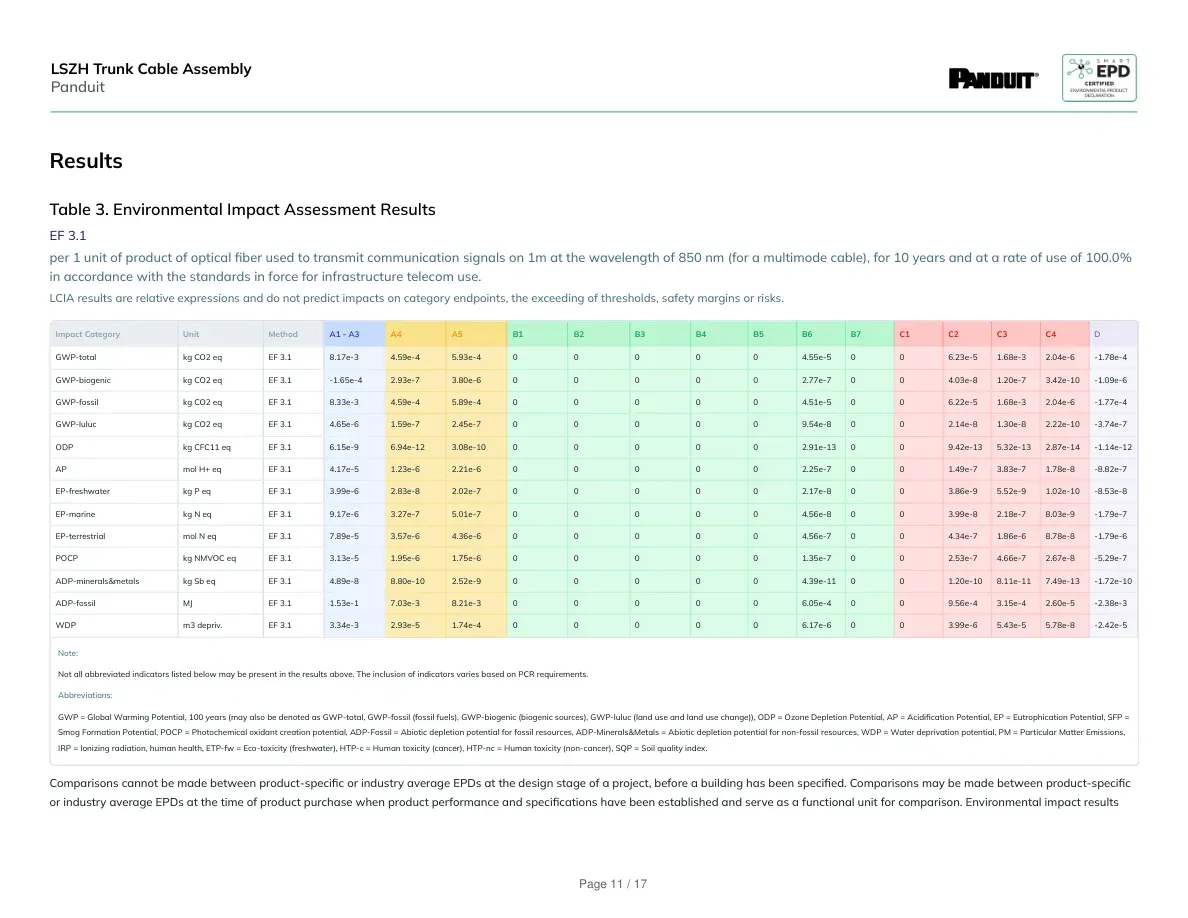
ResultsTable 3. Environmental Impact Assessment ResultsEF 3.1per 1 unit of product of optical fiber used to transmit communication signals on 1m at the wavelength of 850 nm (for a multimode cable), for 10 years and at a rate of use of 100.0%in accordance with the standards in force for infrastructure telecom use.LCIA results are relative expressions and do not predict impacts on category endpoints, the exceeding of thresholds, safety margins or risks.Impact CategoryUnitMethodA1 - A3A4A5B1B2B3B4B5B6B7C1C2C3C4DGWP-totalkg CO2 eqEF 3.18.17e-34.59e-45.93e-4000004.55e-5006.23e-51.68e-32.04e-6-1.78e-4GWP-biogenickg CO2 eqEF 3.1-1.65e-42.93e-73.80e-6000002.77e-7004.03e-81.20e-73.42e-10-1.09e-6GWP-fossilkg CO2 eqEF 3.18.33e-34.59e-45.89e-4000004.51e-5006.22e-51.68e-32.04e-6-1.77e-4GWP-luluckg CO2 eqEF 3.14.65e-61.59e-72.45e-7000009.54e-8002.14e-81.30e-82.22e-10-3.74e-7ODPkg CFC11 eqEF 3.16.15e-96.94e-123.08e-10000002.91e-13009.42e-135.32e-132.87e-14-1.14e-12APmol H+ eqEF 3.14.17e-51.23e-62.21e-6000002.25e-7001.49e-73.83e-71.78e-8-8.82e-7EP-freshwaterkg P eqEF 3.13.99e-62.83e-82.02e-7000002.17e-8003.86e-95.52e-91.02e-10-8.53e-8EP-marinekg N eqEF 3.19.17e-63.27e-75.01e-7000004.56e-8003.99e-82.18e-78.03e-9-1.79e-7EP-terrestrialmol N eqEF 3.17.89e-53.57e-64.36e-6000004.56e-7004.34e-71.86e-68.78e-8-1.79e-6POCPkg NMVOC eqEF 3.13.13e-51.95e-61.75e-6000001.35e-7002.53e-74.66e-72.67e-8-5.29e-7ADP-minerals&metalskg Sb eqEF 3.14.89e-88.80e-102.52e-9000004.39e-11001.20e-108.11e-117.49e-13-1.72e-10ADP-fossilMJEF 3.11.53e-17.03e-38.21e-3000006.05e-4009.56e-43.15e-42.60e-5-2.38e-3WDPm3 depriv.EF 3.13.34e-32.93e-51.74e-4000006.17e-6003.99e-65.43e-55.78e-8-2.42e-5Note:Not all abbreviated indicators listed below may be present in the results above. The inclusion of indicators varies based on PCR requirements.Abbreviations:GWP = Global Warming Potential, 100 years (may also be denoted as GWP-total, GWP-fossil (fossil fuels), GWP-biogenic (biogenic sources), GWP-luluc (land use and land use change)), ODP = Ozone Depletion Potential, AP = Acidification Potential, EP = Eutrophication Potential, SFP =Smog Formation Potential, POCP = Photochemical oxidant creation potential, ADP-Fossil = Abiotic depletion potential for fossil resources, ADP-Minerals&Metals = Abiotic depletion potential for non-fossil resources, WDP = Water deprivation potential, PM = Particular Matter Emissions,IRP = Ionizing radiation, human health, ETP-fw = Eco-toxicity (freshwater), HTP-c = Human toxicity (cancer), HTP-nc = Human toxicity (non-cancer), SQP = Soil quality index.Comparisons cannot be made between product-specific or industry average EPDs at the design stage of a project, before a building has been specified. Comparisons may be made between product-specificor industry average EPDs at the time of product purchase when product performance and specifications have been established and serve as a functional unit for comparison. Environmental impact resultsLSZH Trunk Cable AssemblyPanduitPage 11 / 17
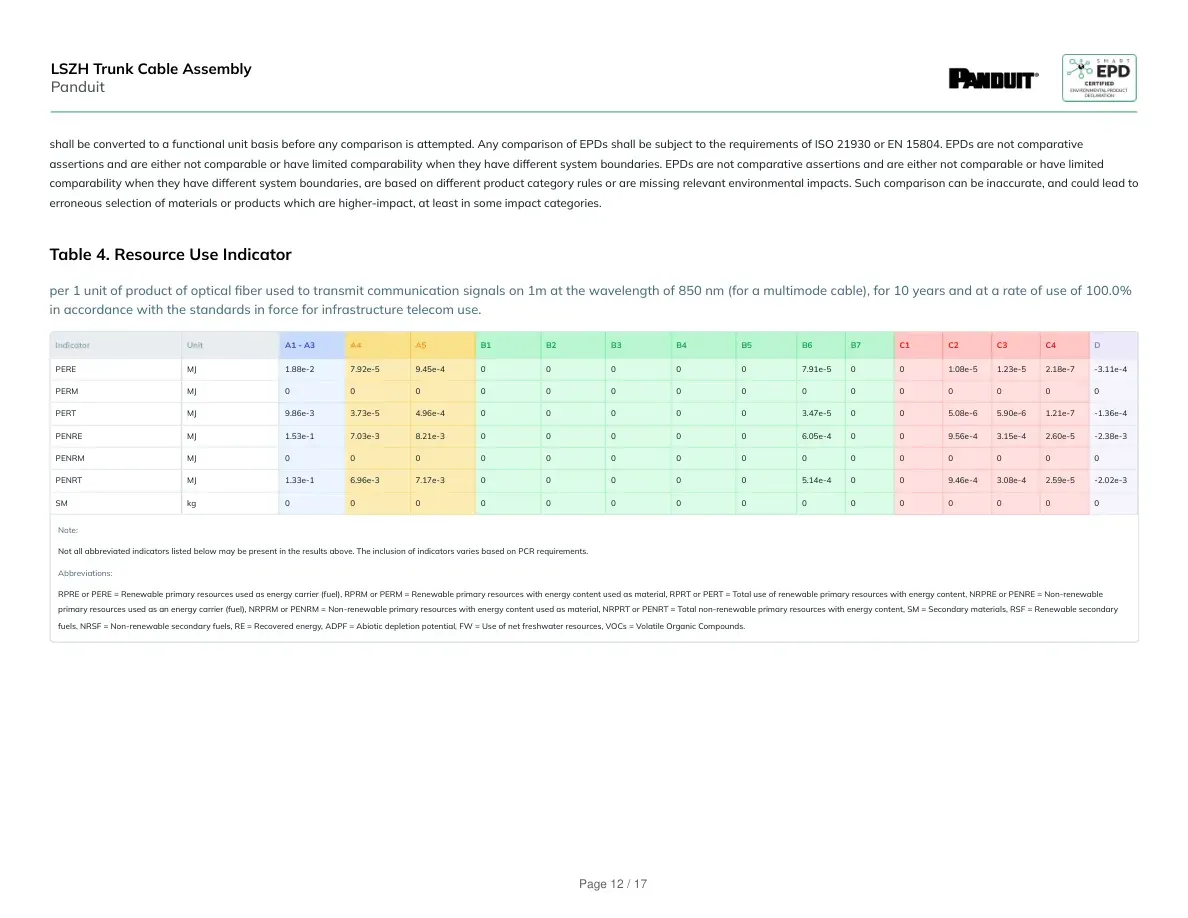
shall be converted to a functional unit basis before any comparison is attempted. Any comparison of EPDs shall be subject to the requirements of ISO 21930 or EN 15804. EPDs are not comparativeassertions and are either not comparable or have limited comparability when they have different system boundaries. EPDs are not comparative assertions and are either not comparable or have limitedcomparability when they have different system boundaries, are based on different product category rules or are missing relevant environmental impacts. Such comparison can be inaccurate, and could lead toerroneous selection of materials or products which are higher-impact, at least in some impact categories.Table 4. Resource Use Indicatorper 1 unit of product of optical fiber used to transmit communication signals on 1m at the wavelength of 850 nm (for a multimode cable), for 10 years and at a rate of use of 100.0%in accordance with the standards in force for infrastructure telecom use.IndicatorUnitA1 - A3A4A5B1B2B3B4B5B6B7C1C2C3C4DPEREMJ1.88e-27.92e-59.45e-4000007.91e-5001.08e-51.23e-52.18e-7-3.11e-4PERMMJ000000000000000PERTMJ9.86e-33.73e-54.96e-4000003.47e-5005.08e-65.90e-61.21e-7-1.36e-4PENREMJ1.53e-17.03e-38.21e-3000006.05e-4009.56e-43.15e-42.60e-5-2.38e-3PENRMMJ000000000000000PENRTMJ1.33e-16.96e-37.17e-3000005.14e-4009.46e-43.08e-42.59e-5-2.02e-3SMkg000000000000000Note:Not all abbreviated indicators listed below may be present in the results above. The inclusion of indicators varies based on PCR requirements.Abbreviations:RPRE or PERE = Renewable primary resources used as energy carrier (fuel), RPRM or PERM = Renewable primary resources with energy content used as material, RPRT or PERT = Total use of renewable primary resources with energy content, NRPRE or PENRE = Non-renewableprimary resources used as an energy carrier (fuel), NRPRM or PENRM = Non-renewable primary resources with energy content used as material, NRPRT or PENRT = Total non-renewable primary resources with energy content, SM = Secondary materials, RSF = Renewable secondaryfuels, NRSF = Non-renewable secondary fuels, RE = Recovered energy, ADPF = Abiotic depletion potential, FW = Use of net freshwater resources, VOCs = Volatile Organic Compounds.LSZH Trunk Cable AssemblyPanduitPage 12 / 17
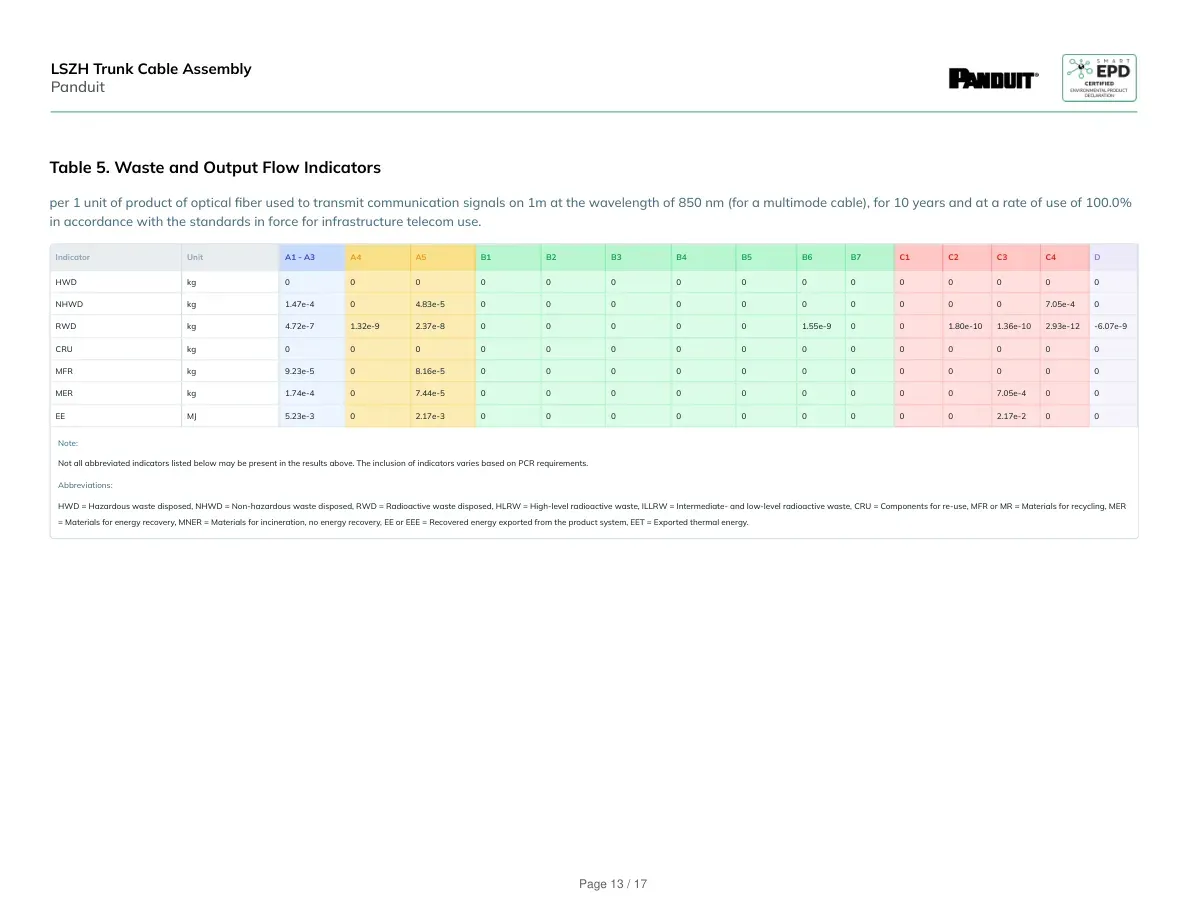
Table 5. Waste and Output Flow Indicatorsper 1 unit of product of optical fiber used to transmit communication signals on 1m at the wavelength of 850 nm (for a multimode cable), for 10 years and at a rate of use of 100.0%in accordance with the standards in force for infrastructure telecom use.IndicatorUnitA1 - A3A4A5B1B2B3B4B5B6B7C1C2C3C4DHWDkg000000000000000NHWDkg1.47e-404.83e-500000000007.05e-40RWDkg4.72e-71.32e-92.37e-8000001.55e-9001.80e-101.36e-102.93e-12-6.07e-9CRUkg000000000000000MFRkg9.23e-508.16e-5000000000000MERkg1.74e-407.44e-50000000007.05e-400EEMJ5.23e-302.17e-30000000002.17e-200Note:Not all abbreviated indicators listed below may be present in the results above. The inclusion of indicators varies based on PCR requirements.Abbreviations:HWD = Hazardous waste disposed, NHWD = Non-hazardous waste disposed, RWD = Radioactive waste disposed, HLRW = High-level radioactive waste, ILLRW = Intermediate- and low-level radioactive waste, CRU = Components for re-use, MFR or MR = Materials for recycling, MER= Materials for energy recovery, MNER = Materials for incineration, no energy recovery, EE or EEE = Recovered energy exported from the product system, EET = Exported thermal energy.LSZH Trunk Cable AssemblyPanduitPage 13 / 17
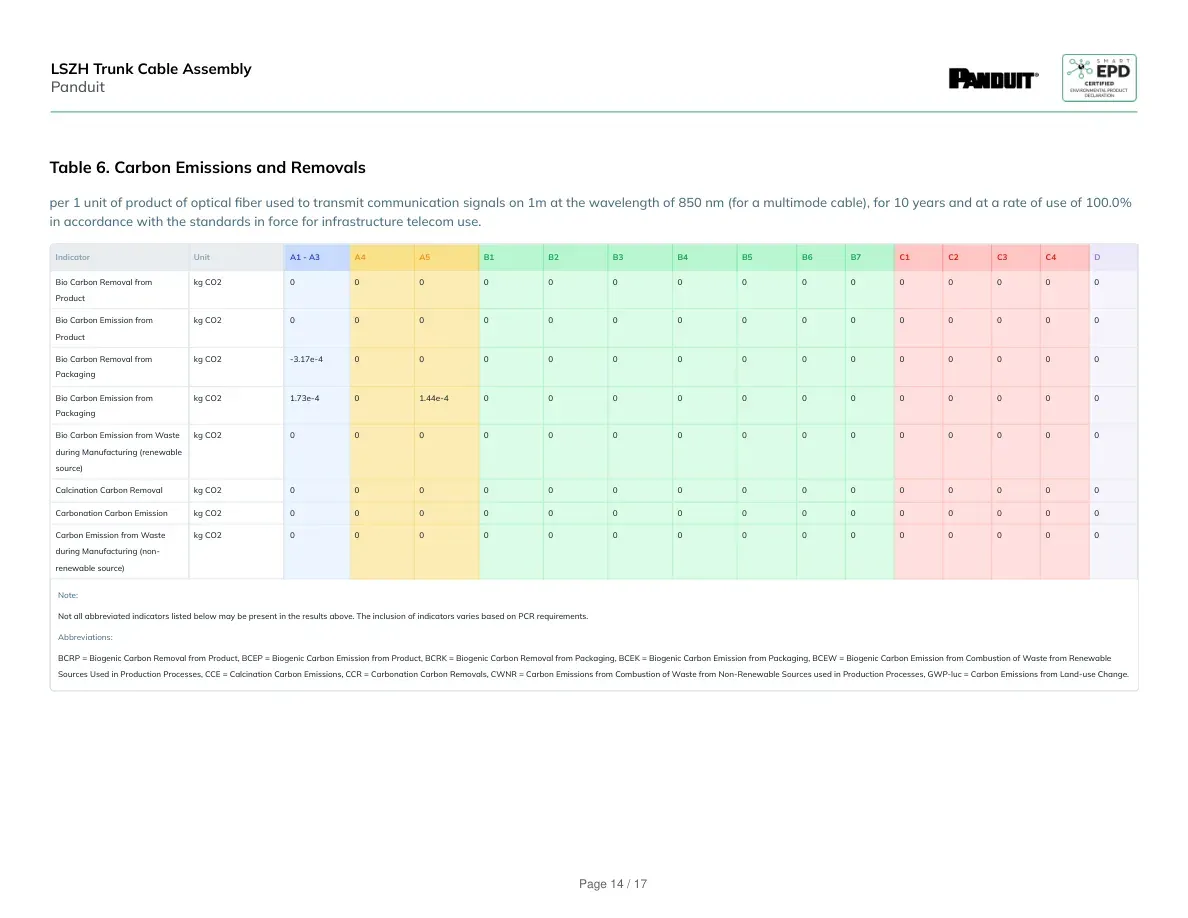
Table 6. Carbon Emissions and Removalsper 1 unit of product of optical fiber used to transmit communication signals on 1m at the wavelength of 850 nm (for a multimode cable), for 10 years and at a rate of use of 100.0%in accordance with the standards in force for infrastructure telecom use.IndicatorUnitA1 - A3A4A5B1B2B3B4B5B6B7C1C2C3C4DBio Carbon Removal fromProductkg CO2000000000000000Bio Carbon Emission fromProductkg CO2000000000000000Bio Carbon Removal fromPackagingkg CO2-3.17e-400000000000000Bio Carbon Emission fromPackagingkg CO21.73e-401.44e-4000000000000Bio Carbon Emission from Wasteduring Manufacturing (renewablesource)kg CO2000000000000000Calcination Carbon Removalkg CO2000000000000000Carbonation Carbon Emissionkg CO2000000000000000Carbon Emission from Wasteduring Manufacturing (non-renewable source)kg CO2000000000000000Note:Not all abbreviated indicators listed below may be present in the results above. The inclusion of indicators varies based on PCR requirements.Abbreviations:BCRP = Biogenic Carbon Removal from Product, BCEP = Biogenic Carbon Emission from Product, BCRK = Biogenic Carbon Removal from Packaging, BCEK = Biogenic Carbon Emission from Packaging, BCEW = Biogenic Carbon Emission from Combustion of Waste from RenewableSources Used in Production Processes, CCE = Calcination Carbon Emissions, CCR = Carbonation Carbon Removals, CWNR = Carbon Emissions from Combustion of Waste from Non-Renewable Sources used in Production Processes, GWP-luc = Carbon Emissions from Land-use Change.LSZH Trunk Cable AssemblyPanduitPage 14 / 17
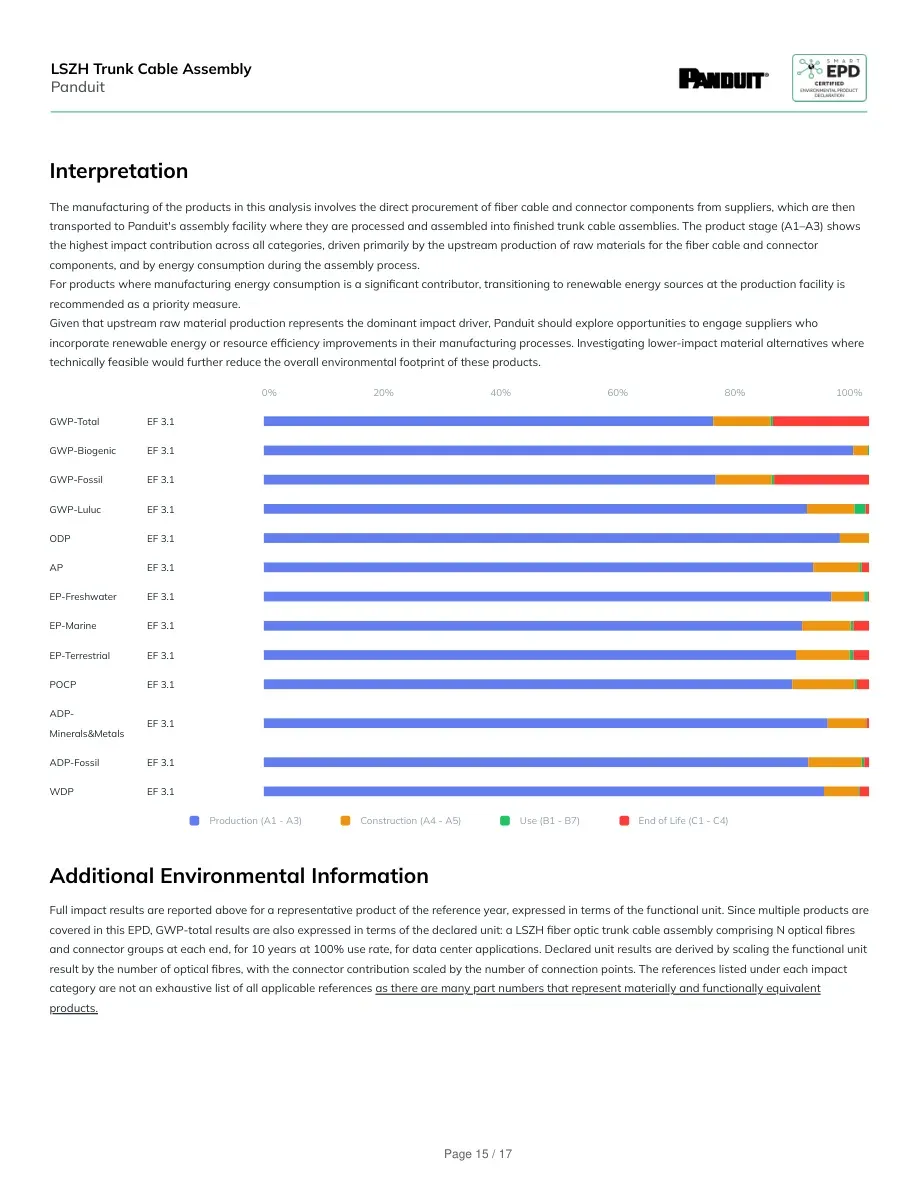
InterpretationThe manufacturing of the products in this analysis involves the direct procurement of fiber cable and connector components from suppliers, which are thentransported to Panduit's assembly facility where they are processed and assembled into finished trunk cable assemblies. The product stage (A1–A3) showsthe highest impact contribution across all categories, driven primarily by the upstream production of raw materials for the fiber cable and connectorcomponents, and by energy consumption during the assembly process.For products where manufacturing energy consumption is a significant contributor, transitioning to renewable energy sources at the production facility isrecommended as a priority measure.Given that upstream raw material production represents the dominant impact driver, Panduit should explore opportunities to engage suppliers whoincorporate renewable energy or resource efficiency improvements in their manufacturing processes. Investigating lower-impact material alternatives wheretechnically feasible would further reduce the overall environmental footprint of these products.0%20%40%60%80%100%GWP-TotalEF 3.1GWP-BiogenicEF 3.1GWP-FossilEF 3.1GWP-LulucEF 3.1ODPEF 3.1APEF 3.1EP-FreshwaterEF 3.1EP-MarineEF 3.1EP-TerrestrialEF 3.1POCPEF 3.1ADP-Minerals&MetalsEF 3.1ADP-FossilEF 3.1WDPEF 3.1Production (A1 - A3)Construction (A4 - A5)Use (B1 - B7)End of Life (C1 - C4)Additional Environmental InformationFull impact results are reported above for a representative product of the reference year, expressed in terms of the functional unit. Since multiple products arecovered in this EPD, GWP-total results are also expressed in terms of the declared unit: a LSZH fiber optic trunk cable assembly comprising N optical fibresand connector groups at each end, for 10 years at 100% use rate, for data center applications. Declared unit results are derived by scaling the functional unitresult by the number of optical fibres, with the connector contribution scaled by the number of connection points. The references listed under each impactcategory are not an exhaustive list of all applicable references as there are many part numbers that represent materially and functionally equivalentproducts.LSZH Trunk Cable AssemblyPanduitPage 15 / 17
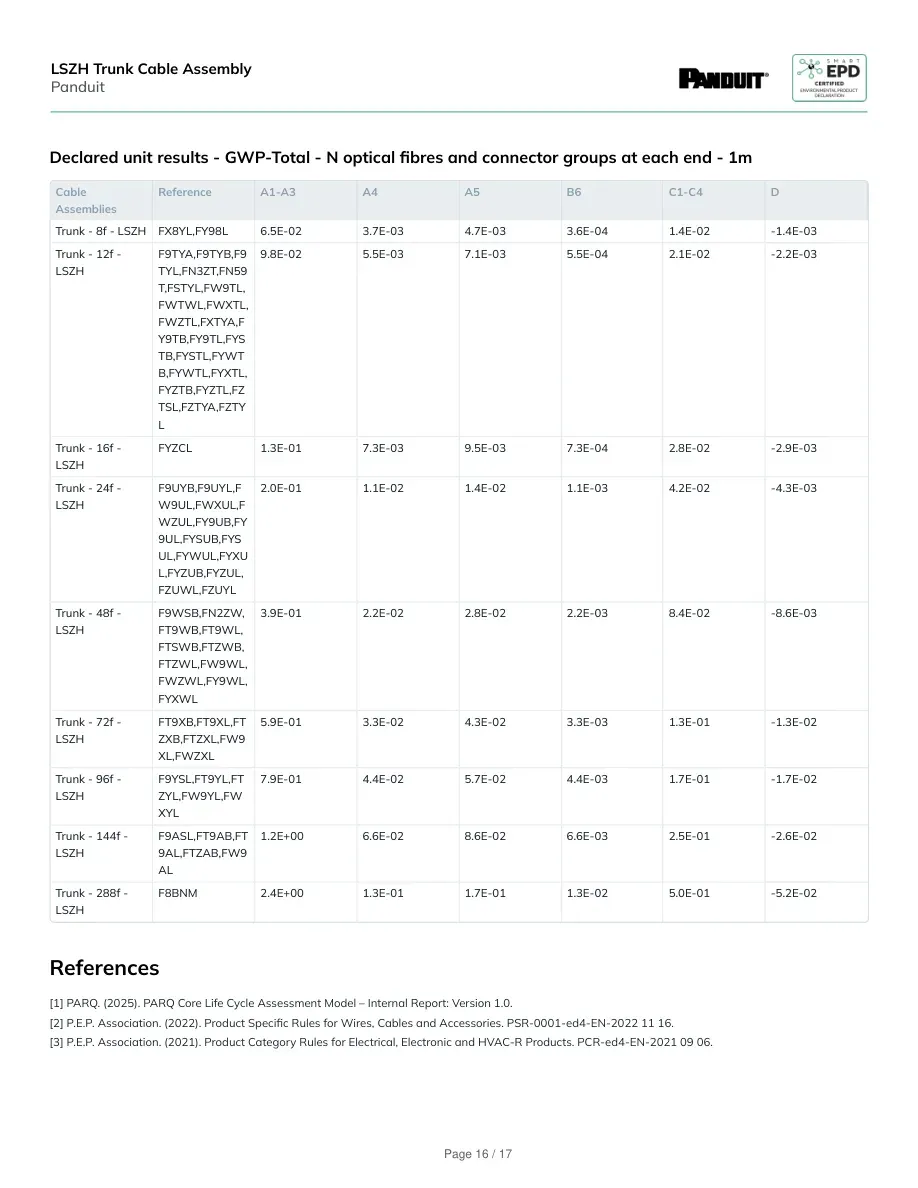
Declared unit results - GWP-Total - N optical fibres and connector groups at each end - 1mCableAssembliesReferenceA1-A3A4A5B6C1-C4DTrunk - 8f - LSZHFX8YL,FY98L6.5E-023.7E-034.7E-033.6E-041.4E-02-1.4E-03Trunk - 12f -LSZHF9TYA,F9TYB,F9TYL,FN3ZT,FN59T,FSTYL,FW9TL,FWTWL,FWXTL,FWZTL,FXTYA,FY9TB,FY9TL,FYSTB,FYSTL,FYWTB,FYWTL,FYXTL,FYZTB,FYZTL,FZTSL,FZTYA,FZTYL9.8E-025.5E-037.1E-035.5E-042.1E-02-2.2E-03Trunk - 16f -LSZHFYZCL1.3E-017.3E-039.5E-037.3E-042.8E-02-2.9E-03Trunk - 24f -LSZHF9UYB,F9UYL,FW9UL,FWXUL,FWZUL,FY9UB,FY9UL,FYSUB,FYSUL,FYWUL,FYXUL,FYZUB,FYZUL,FZUWL,FZUYL2.0E-011.1E-021.4E-021.1E-034.2E-02-4.3E-03Trunk - 48f -LSZHF9WSB,FN2ZW,FT9WB,FT9WL,FTSWB,FTZWB,FTZWL,FW9WL,FWZWL,FY9WL,FYXWL3.9E-012.2E-022.8E-022.2E-038.4E-02-8.6E-03Trunk - 72f -LSZHFT9XB,FT9XL,FTZXB,FTZXL,FW9XL,FWZXL5.9E-013.3E-024.3E-023.3E-031.3E-01-1.3E-02Trunk - 96f -LSZHF9YSL,FT9YL,FTZYL,FW9YL,FWXYL7.9E-014.4E-025.7E-024.4E-031.7E-01-1.7E-02Trunk - 144f -LSZHF9ASL,FT9AB,FT9AL,FTZAB,FW9AL1.2E+006.6E-028.6E-026.6E-032.5E-01-2.6E-02Trunk - 288f -LSZHF8BNM2.4E+001.3E-011.7E-011.3E-025.0E-01-5.2E-02References[1] PARQ. (2025). PARQ Core Life Cycle Assessment Model – Internal Report: Version 1.0.[2] P.E.P. Association. (2022). Product Specific Rules for Wires, Cables and Accessories. PSR-0001-ed4-EN-2022 11 16.[3] P.E.P. Association. (2021). Product Category Rules for Electrical, Electronic and HVAC-R Products. PCR-ed4-EN-2021 09 06.LSZH Trunk Cable AssemblyPanduitPage 16 / 17
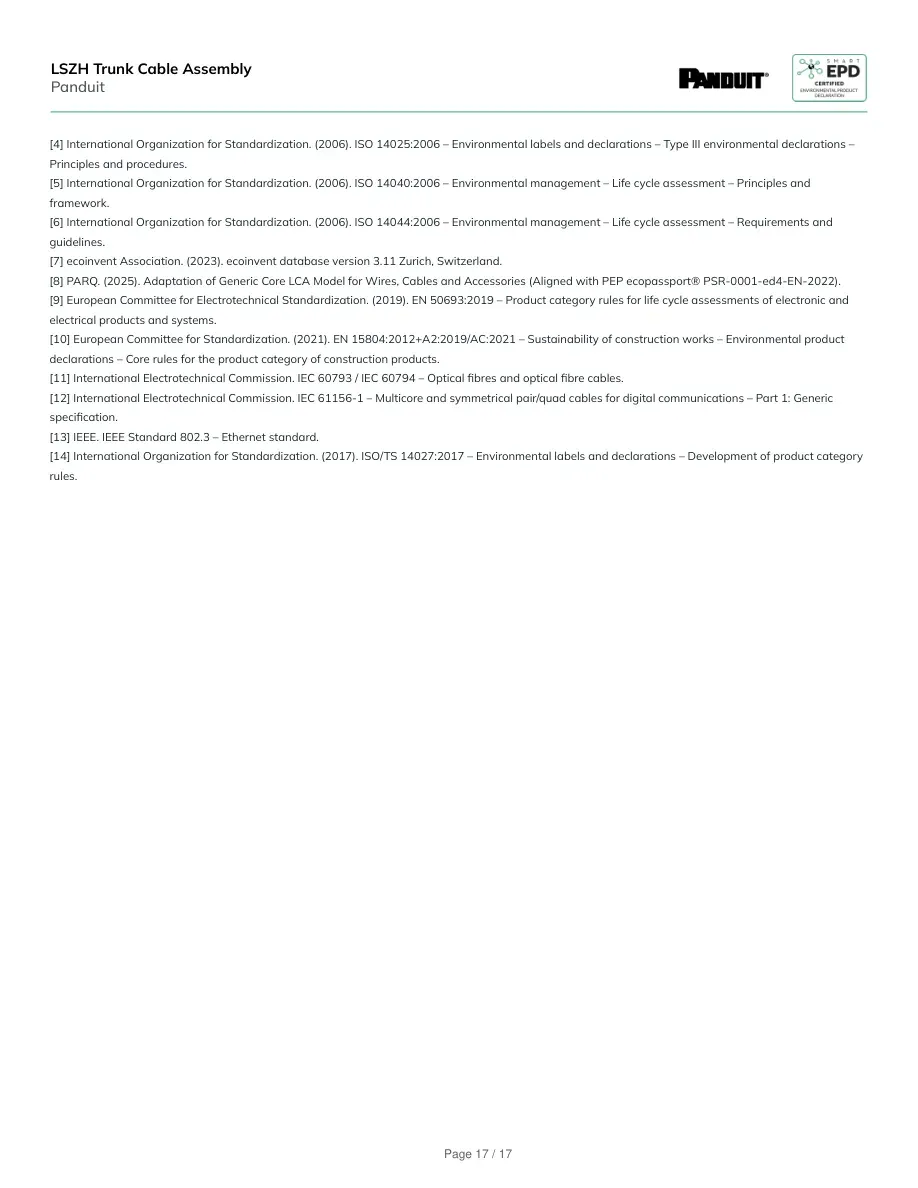
[4] International Organization for Standardization. (2006). ISO 14025:2006 – Environmental labels and declarations – Type III environmental declarations –Principles and procedures.[5] International Organization for Standardization. (2006). ISO 14040:2006 – Environmental management – Life cycle assessment – Principles andframework.[6] International Organization for Standardization. (2006). ISO 14044:2006 – Environmental management – Life cycle assessment – Requirements andguidelines.[7] ecoinvent Association. (2023). ecoinvent database version 3.11 Zurich, Switzerland.[8] PARQ. (2025). Adaptation of Generic Core LCA Model for Wires, Cables and Accessories (Aligned with PEP ecopassport® PSR-0001-ed4-EN-2022).[9] European Committee for Electrotechnical Standardization. (2019). EN 50693:2019 – Product category rules for life cycle assessments of electronic andelectrical products and systems.[10] European Committee for Standardization. (2021). EN 15804:2012+A2:2019/AC:2021 – Sustainability of construction works – Environmental productdeclarations – Core rules for the product category of construction products.[11] International Electrotechnical Commission. IEC 60793 / IEC 60794 – Optical fibres and optical fibre cables.[12] International Electrotechnical Commission. IEC 61156-1 – Multicore and symmetrical pair/quad cables for digital communications – Part 1: Genericspecification.[13] IEEE. IEEE Standard 802.3 – Ethernet standard.[14] International Organization for Standardization. (2017). ISO/TS 14027:2017 – Environmental labels and declarations – Development of product categoryrules.LSZH Trunk Cable AssemblyPanduitPage 17 / 17
